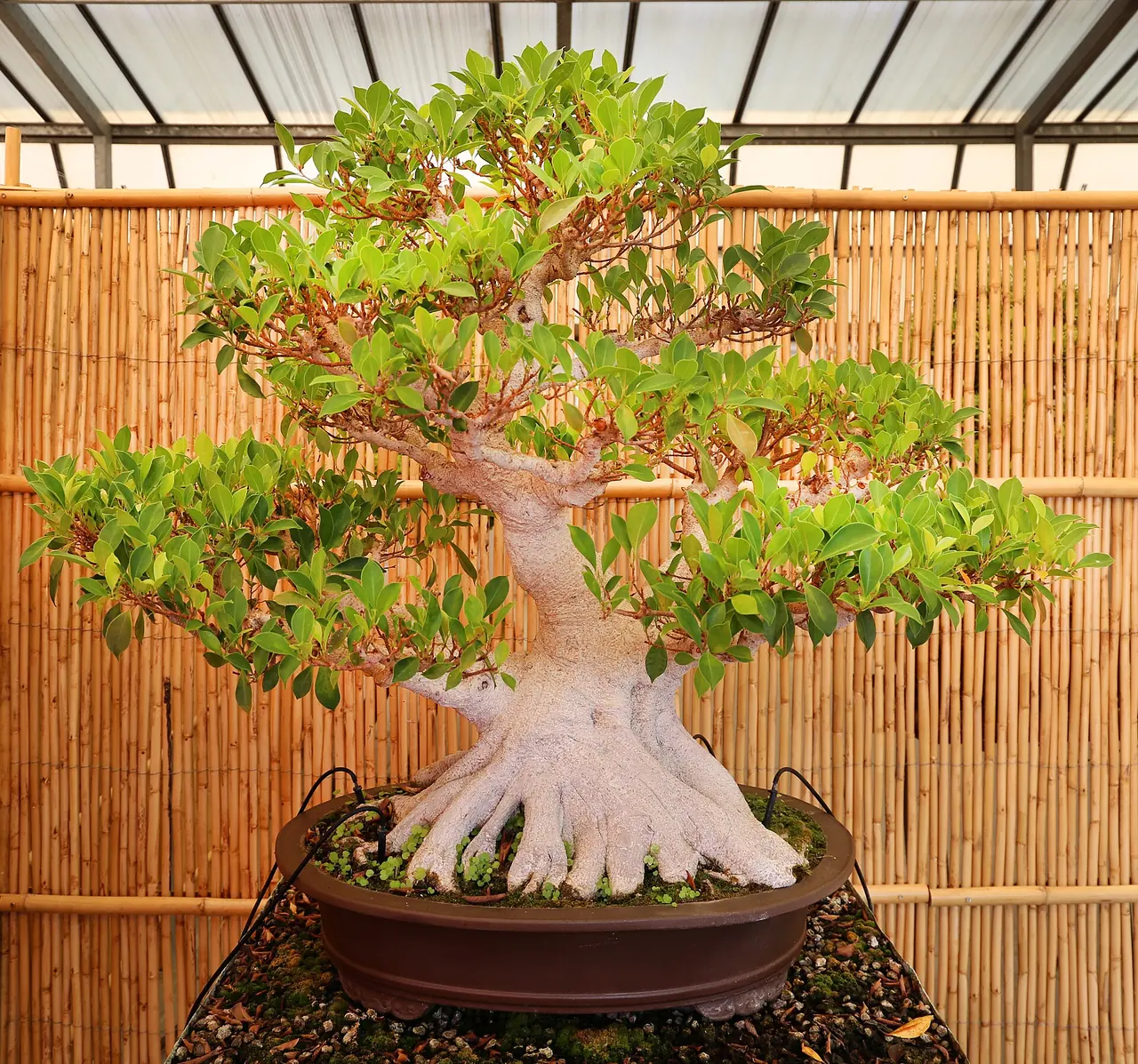
First find out what tree you have, because that decides where it lives. Some gift trees are outdoor trees that weaken and die slowly indoors, such as the juniper, often sold with an "indoor bonsai" tag; others are tropical and need your brightest window through a cold winter, and ficus is the easiest of those. Then do little: one good spot, water as the soil begins to dry, and no styling yet.
What is it, and where does it live?
| Tree | How to recognise it | Where it lives |
|---|---|---|
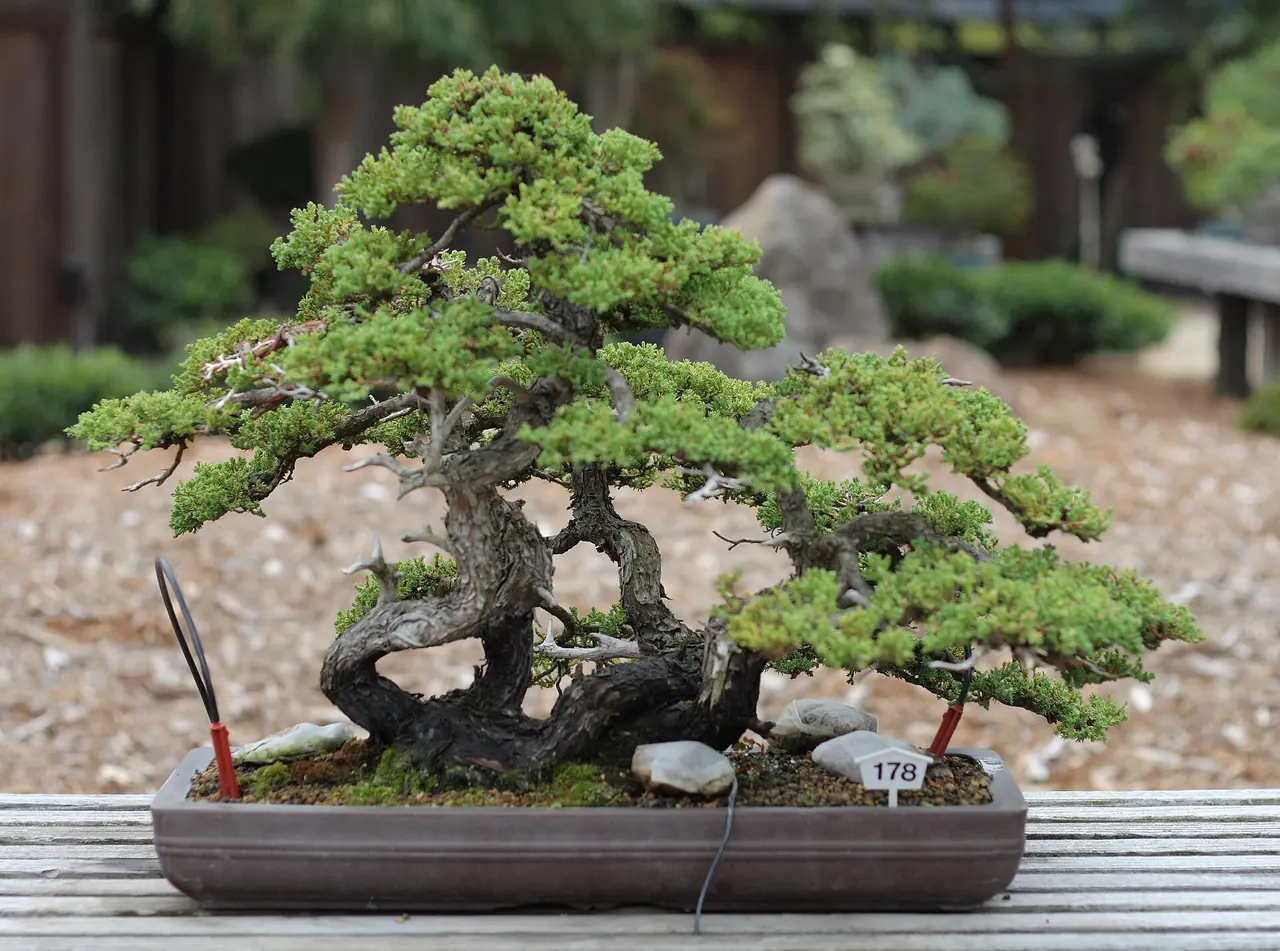
| Juniper (often Juniperus procumbens 'Nana', green mound juniper) | Prickly blue-green to grey-green needles in threes; low, spreading branches | Outdoors |
| Chinese elm | Small, glossy, toothed, slightly asymmetrical leaves; mottled, flaking bark with orange patches | Indoors or out; stronger outdoors |
| Ficus | Glossy, leathery leaves, milky sap; the "ginseng" form has a swollen root base | Indoors in a cold climate, outdoors when warm |
| Dwarf jade (Portulacaria afra) | Round, fleshy leaves ½ to ¾ inch long on reddish-brown stems | Indoors in a temperate climate |
| Serissa | Small, shiny oval leaves, tiny white flowers, a bad smell when cut | Indoors from autumn to spring |
| Fukien tea | Small, dark, leathery leaves with fine white hairs and a notched tip | Indoors, except in very warm climates |
| Podocarpus | Narrow leaves like a yew's, set spirally | Indoors, better outside in summer in semi-shade |
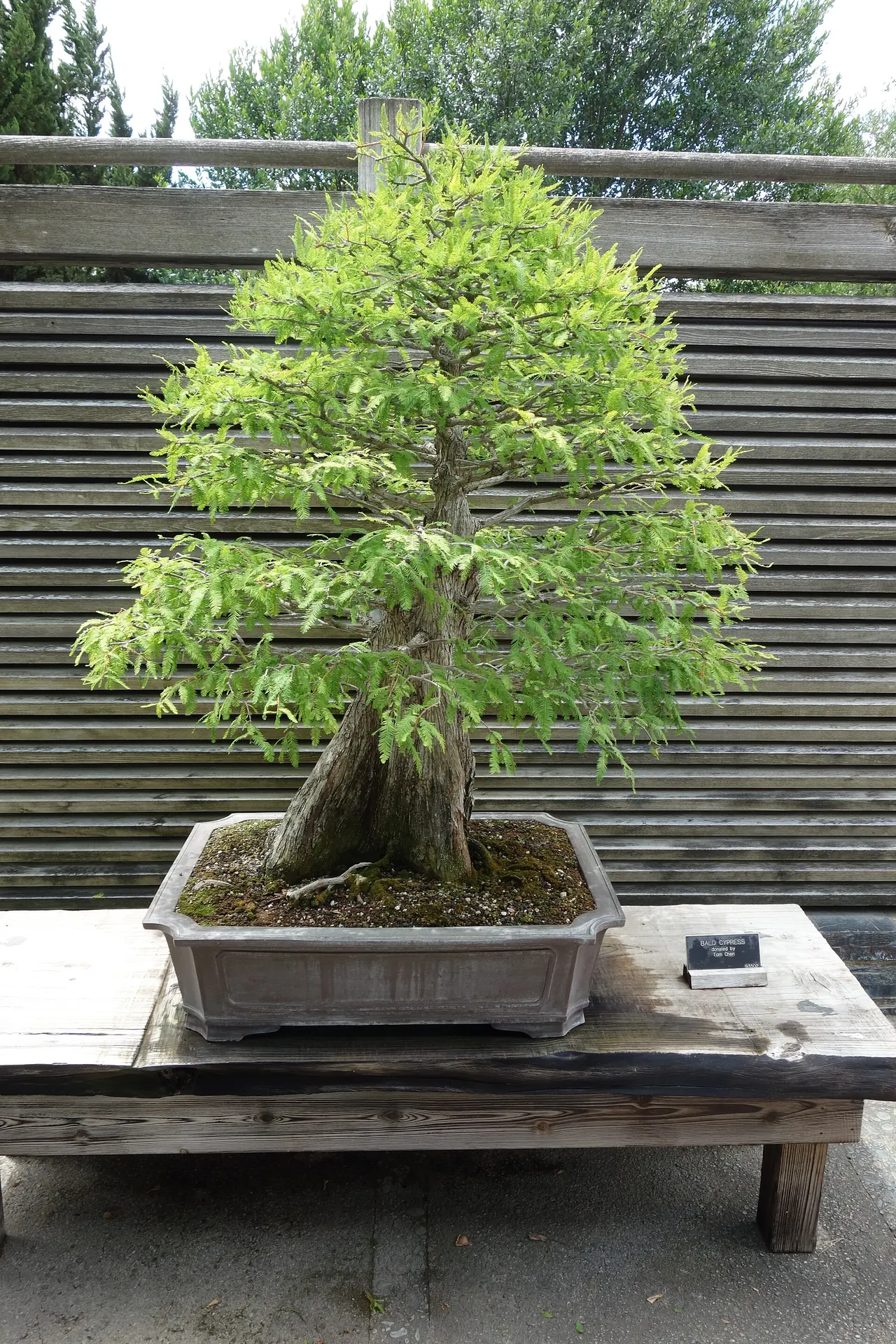
| Dawn redwood, bald cypress | Soft, flat needles, opposite on dawn redwood, alternate on bald cypress | Outdoors |
Species by species
Juniper
Junipers are outdoor trees; as Lavigne puts it, "if it's a juniper, it needs to be outside. Outside." Indoors the light is too low, the air too dry and there is no winter rest, so the tree weakens and dies. A dead juniper can stay green for weeks or months, so an indoor one can look fine long after it has failed.
Move it out in stages: Lavigne starts on the windowsill, moves it to the doorstep outside, then into the shade of a tree. Mall junipers usually sit in ordinary potting soil with small pebbles glued on top, sometimes in a pot with no drainage hole, and this juniper does not tolerate wet soil. The pebbles must come off; Lavigne uses a hammer and chisel. Water when the top half of the soil has dried, as the New York Botanical Garden advises, and protect the pot below −10 °C (15 °F), as Bonsai Empire does.
Chinese elm
The elm is semi-evergreen: outdoors in a cold autumn it drops some or all of its leaves, while indoors or in a very mild winter it stays green. Growers differ on keeping it indoors: Bonsai Empire says yes, "but it's not always ideal", while Harrington finds an indoor elm never as vigorous. It dislikes both drought and constant wet; Herons says most elms are killed by wrong watering. A bone-dry pot suddenly flooded can make it drop its leaves, PenJing8 reports.
Ficus
The ginseng ficus's fat "trunk" is, Lavigne explains, a young Ficus microcarpa's roots, lifted clear of the soil, and he counts about half as carrying grafted, smaller-leaved foliage. Bonsai Empire notes that ginseng ficus are poisonous to animals.
Give it several hours of direct sun within about 1 m of the window; in low light it grows larger leaves and drops them. Ficus react to big changes in light, such as a nursery shadehouse to a dim room, a Florida guide warns; NC State notes a moved weeping fig may shed its leaves and grow new ones suited to the new light. Once conditions are right it re-leafs in 3 to 6 weeks. Bring it in as nights cool to 10 to 15 °C; it is damaged below 4 to 7 °C, and a freeze may kill it.
Dwarf jade (not the jade plant)
The dwarf jade sold as bonsai is Portulacaria afra, which Wisconsin Extension notes is not related to the jade plant, Crassula ovata, whose leaves run about 1 to 3½ inches. Bonsai Empire wants full sun, with red leaf edges showing enough light; the RHS suggests bright, indirect light. Water sparingly, since a jade kept wet drops its leaves and rots at the stem, and keep it above 5 °C.
Serissa
Bonsai Empire and Lavigne both call serissa hard for beginners, and Lavigne says it drops its leaves "at the least provocation". Keep it in one place and water a little less after leaf drop, because a leafless serissa that is overwatered rots at the roots.
Fukien tea
Bonsai Empire sets Fukien tea beside a window, getting several hours of strong light, and Mistral Bonsai less than half a metre from the glass. After a move it drops leaves, and Bonsai Empire expects new buds within a few weeks; Lavigne lets it shed them by itself. Even white dots on the upper side of mature leaves are normal hairs, not pests.
Podocarpus
Bonsai Empire keeps podocarpus slightly moist, never waterlogged; its cold limit is disputed (below).
Dawn redwood and bald cypress
Both are deciduous conifers: in autumn the needles turn orange-brown or copper and fall, bald cypress dropping small twigs with them. That is normal; browning in spring or summer is not, so check for a dry or waterlogged rootball, heat or mites. Do not bring a bare tree into the warm to force leaves; look for dormant buds. Bald cypress "needs a lot of water", and Bonsai Empire stands its pot in a shallow bowl of water in summer.
Indoor light, in numbers
Bonsai sources give no light measurements, so these figures are from US extension services, in foot-candles (fc) as they publish them.
- Outdoors in full sun: 10,000 fc (NC State); 10,000 to 12,000 fc (Illinois).
- Right in front of a south window: about 1,500 fc (Illinois).
- Up to 5 ft from a south window, or right at an east or west one: about 300 fc; 3 to 10 ft from a south window, or at a north one: about 150 fc.
- Office lighting: 50 fc (NC State).
- A nursery-acclimatised ficus suits indoor light of 100 to 200 fc, the Florida production guide says.
Light drops sharply a few feet back from the glass, Bonsai Empire warns. These window directions come from northern-hemisphere sources. Lamps help, but cannot replace outdoor conditions for trees that need the seasons.
The first weeks, step by step
- Identify the tree from its label and leaves.
- Put it where it belongs: an outdoor tree outside, in stages; a tropical at the brightest window, away from radiators, heaters and air conditioners.
- Check the pot: lift off glued pebbles and look for a drainage hole.
- Water by the soil, not the calendar, pushing a finger in, as the surface can look wet over a dry rootball.
- Leave it alone: about four weeks without pruning, repotting or feeding for a ficus brought indoors; Lavigne would not style a mall juniper "until you've kept the tree alive for at least half a year".
- Expect some leaf drop on ficus, serissa and Fukien tea, and water a leafless tree less, not more.
- Plan for winter: outdoor trees stay out, pots protected in hard cold; tropicals come in as nights cool.
Where growers differ
The first repot of a mall juniper. Growers differ, with no recommended way. Lavigne, in Florida, leaves the soil "about a year, or more"; his own first juniper stayed in its original soil for about 3 years, then died root-bound. Dupuich, in the San Francisco Bay Area, repotted a procumbens 'Nana' soon after taking it home, removing about half the old soil. Bjorholm, Hagedorn, Mirai and Dupuich never bare-root a juniper. If you repot, our recommended season, following Bjorholm, is early spring as the foliage begins to green; Harrington, in the UK, prefers late summer to early autumn.
Why the pebbles must go. Lavigne: only because you cannot judge how wet the soil is. The Better Bonsai primer: glue and rocks keep water out and "can kill the plant".
Juniper as a first tree, by climate. Growers differ by region, with no recommended way. In Florida's humid subtropical climate Lavigne writes "I do not recommend the juniper to a novice. Period.", estimating the chance of a first juniper dying as "close to 80%". In the UK's mild temperate climate a beginners' guide rates Chinese juniper easy to moderate, and Yorkshire Bonsai lists juniper among the best for beginners. A Mediterranean guide calls juniper forgiving for beginners.
Whether moving a ficus matters. Growers differ, with no recommended way. UF/IFAS, NC State and a Japanese guide treat a move or a change of light as a main cause of leaf drop. Bonsai Empire gives two versions: its indoor page says moving into a home often triggers adjustment stress, while its ficus FAQ calls changes of location "generally less significant factors" than watering and placement.
Cold limits: bonsai sources against garden zones. Garden ratings assume a plant in the ground, and potted roots are less hardy than the top.
- Podocarpus: Bonsai Empire calls it "not frost-hardy"; NC State gives USDA zones 7a to 9b and grows it outdoors in North Carolina.
- Bald cypress: Bonsai Empire says it "tolerates hardly any frost when it is planted in a container"; NC State gives zones 4a to 9b in the ground.
- Serissa: Bonsai Empire winters it at 10 to 20 °C indoors; NC State gives zones 7a to 11b as a garden shrub.
- Ficus: Bonsai Empire gives two versions of when to bring it in: 15 °C in its care section, nights above 10 °C in its FAQ.
Watering a dawn redwood. Growers differ, with no recommended way. Herons says "Dawn Redwood love water so there's not chance of over watering them"; Shibusa-en says avoid waterlogging, and Yorkshire Bonsai warns that saturated soil can brown it.
Grow-light hours. Growers differ, with no recommended way: about 10 hours a day (Bonsai Empire, indoor trees), 12 to 14 (Bonsai Empire for a weak ficus; Iowa State), 14 to 16 (Illinois) or 15 to 18 (Bonsai Learning Center), never 24.
Related
- Is my bonsai dying? How to tell, and what to do
- Japanese black pine care, season by season
- Japanese maple guide
Sources
- Adam Lavigne, Adam's Art and Bonsai Blog (Orlando, Florida): So you've purchased a mallsai, The ginseng ficus, Beginner bonsai tree selection, Bonsai on Elm Street
- Jonas Dupuich, Bonsai Tonight: Refining a procumbens juniper, Improving drainage in a compacted rootball, How to tell when something is wrong, Identifying weak roots by checking the foliage
- Bonsai Empire: Juniper, Chinese elm, Ficus, Jade, Serissa, Fukien tea, Podocarpus, Bald cypress, Indoor bonsai, Position, Forum: white dots on Fukien tea
- Harry Harrington, bonsai4me: Juniper guide, Ficus, Chinese elm
- Bjorn Bjorholm, Eisei-en: Juniper care guide
- Michael Hagedorn, Crataegus Bonsai: How to pinch junipers
- Bonsai Mirai: Repotting conifers
- Better Bonsai blog: Juniper bonsai for beginners
- New York Botanical Garden: Juniper browning
- Nurseries and retailers: Herons Bonsai FAQ, Yorkshire Bonsai FAQ, Yorkshire Bonsai, dawn redwood care, Yorkshire Bonsai, dawn redwood browning, Mistral Bonsai, Fukien tea, Shibusa-en, dawn redwood
- PenJing8: Indoor Chinese elm yellowing, Elm leaves yellowing and dropping
- Japanese guides: 盆栽コレクション, indoor bonsai
- Beginner guides by climate: Savvy Plus, UK, Make Bonsai, Mediterranean
- Bonsai Learning Center: Winter protection
- Plant science: NC State, Juniperus procumbens, Ulmus parvifolia, Ficus benjamina, Serissa japonica, Podocarpus macrophyllus, Metasequoia, Taxodium distichum, plants grown in containers; Wisconsin Extension, Portulacaria afra, jade plant; RHS, Portulacaria afra; Illinois Extension, houseplant lighting; Iowa State, supplemental light; UF/IFAS, interiorscape ficus; Michael Hagedorn via Bonsai Bark, cold weather bonsai