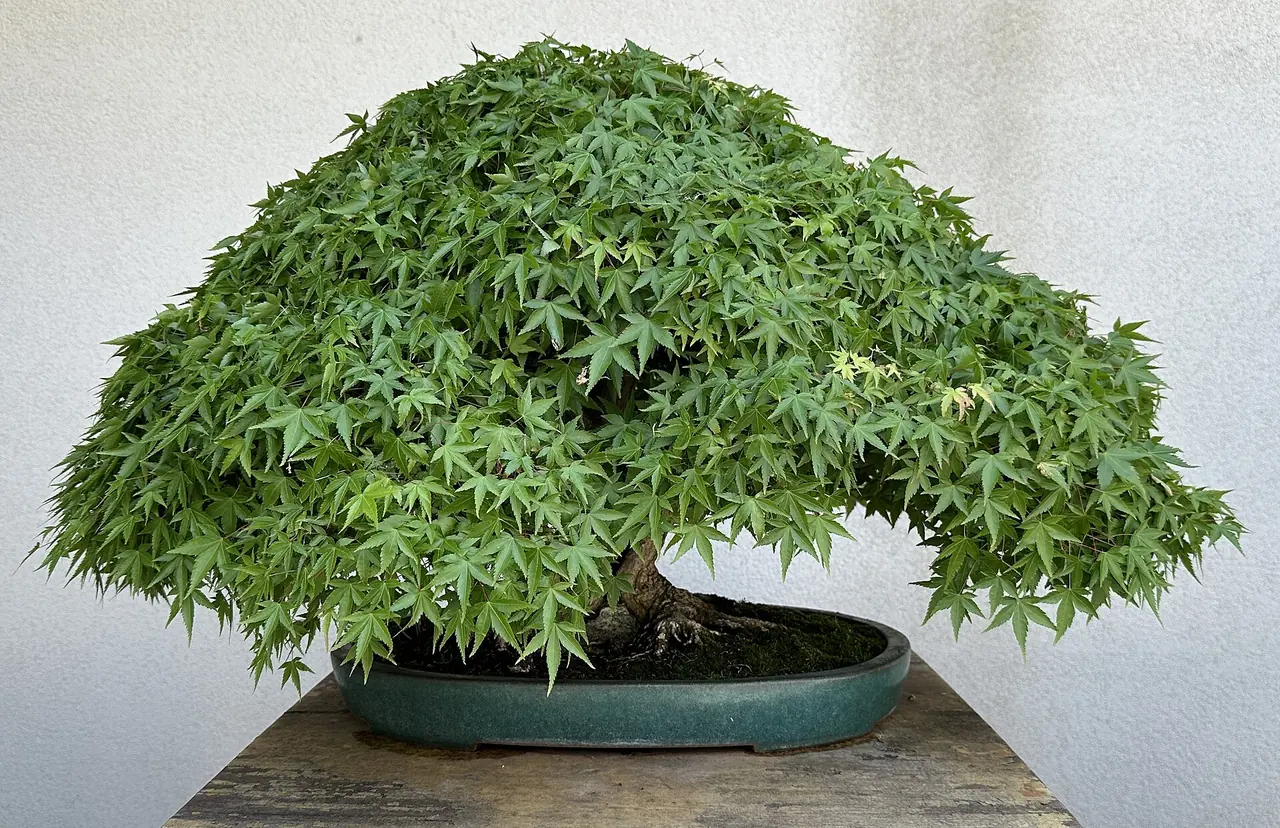
A mature Japanese maple makes one flush of growth a year, so most of its care is about timing that single push of shoots. Give it full sun while new growth emerges, partial shade once summer heat arrives, and never let its pot dry out completely. Pinch a refined tree as the first leaf pair opens, let a young tree grow and cut it back once the spring leaves harden, and repot as the buds swell.
What the tree is
Japanese maple (Acer palmatum) carries its leaves in opposite pairs, so its shoots come in pairs, each pair turned across the one below. Michael Hagedorn calls the mature tree "a single flush plant": one push of growth a year, unless leaf removal or cutting forces a second. Its smooth bark shows every scar. It needs a real winter: Harry Harrington puts the need at no fewer than 44 days under 10 °C.
Most growers cited here garden on the mild, dry-summer US West Coast; Bjorn Bjorholm's guide probably dates from hot-summer Tennessee, Harrington's from the cool UK. So this guide gives tree stages, which carry between climates, not dates. Australian growers' calendars follow the same stages in their own seasons.
The year, stage by stage
- Dormant (winter). Keep it cold; Bjorholm finds it might need water only every 5 to 7 days.
- Bud swell (late winter in a mild climate, early spring where winters are cold). Repot.
- Leaf-out (mid spring). Pinch refined trees as the first leaf pair opens; let young trees grow.
- Spring growth hardened (late spring in Tennessee, later in a cooler spring). Cut back long shoots, thin leaves, start feeding refined trees, and wire.
- Summer. Shade and daily water; Harrington cuts in the midsummer semi-dormant period, when wounds heal fast.
- Leaf colour and drop (autumn). At leaf drop, reduce forks of three or four shoots to two and wire bare branches.
Placement: sun, then summer shade
Full sun in spring gives vigorous growth and smaller leaves. Once summer heat arrives, give morning sun and afternoon shade, because leaves scorch in direct sun with heat and wind above about 29 to 30 °C (85 °F). Bjorholm's nursery puts its maples under 30 to 40% shade cloth through the hot months, and Jonas Dupuich takes his down after the last hot spell. Tie the cloth to that temperature, not a date: a cool summer might need little, our research suggests.
Watering and feeding
Water daily in the growing season and several times on the hottest days. Never let the soil dry right out, and never leave it waterlogged: root rot comes with wet soil and can look like drought.
Young trees are fed heavily from bud opening to the end of the season, so shoots extend and the trunk thickens, though growers differ on nitrogen. A refined tree is not fed until its spring flush has hardened, because early feeding lengthens the year's only flush. Mirai warns that over-feeding reduces fine ramification, and high nitrogen late in summer favours bacterial blight.
Pinching against cutting back
- Refined tree: pinch out the soft tip as the first leaf pair opens, about a day before it unfolds, so the shoot stops at one short internode. Some growers skip pinching altogether for a stronger tree, above all where summers are hot and dry.
- Young or developing tree: do not pinch, since it "stunts development". Let shoots extend until the 4 or 5 leaves at their base have hardened, then cut back to one or two pairs; a cut often throws four shoots.
- Weak branch: Hagedorn says a leaf pair opening with no shoot between can die back; do not pinch it, and feed more.
Leaf work: partial only
We recommend partial leaf removal only, never stripping every leaf, though growers differ (below). On an established, moderately strong tree, remove one leaf of each pair once spring growth hardens, letting light into the inside of the tree so its weak inner shoots survive. Cutting outer leaves in half, from late spring into midsummer, strengthens interior shoots. Shade newly exposed inner leaves for about a month, or they scorch.
Structural cuts and the trunk chop
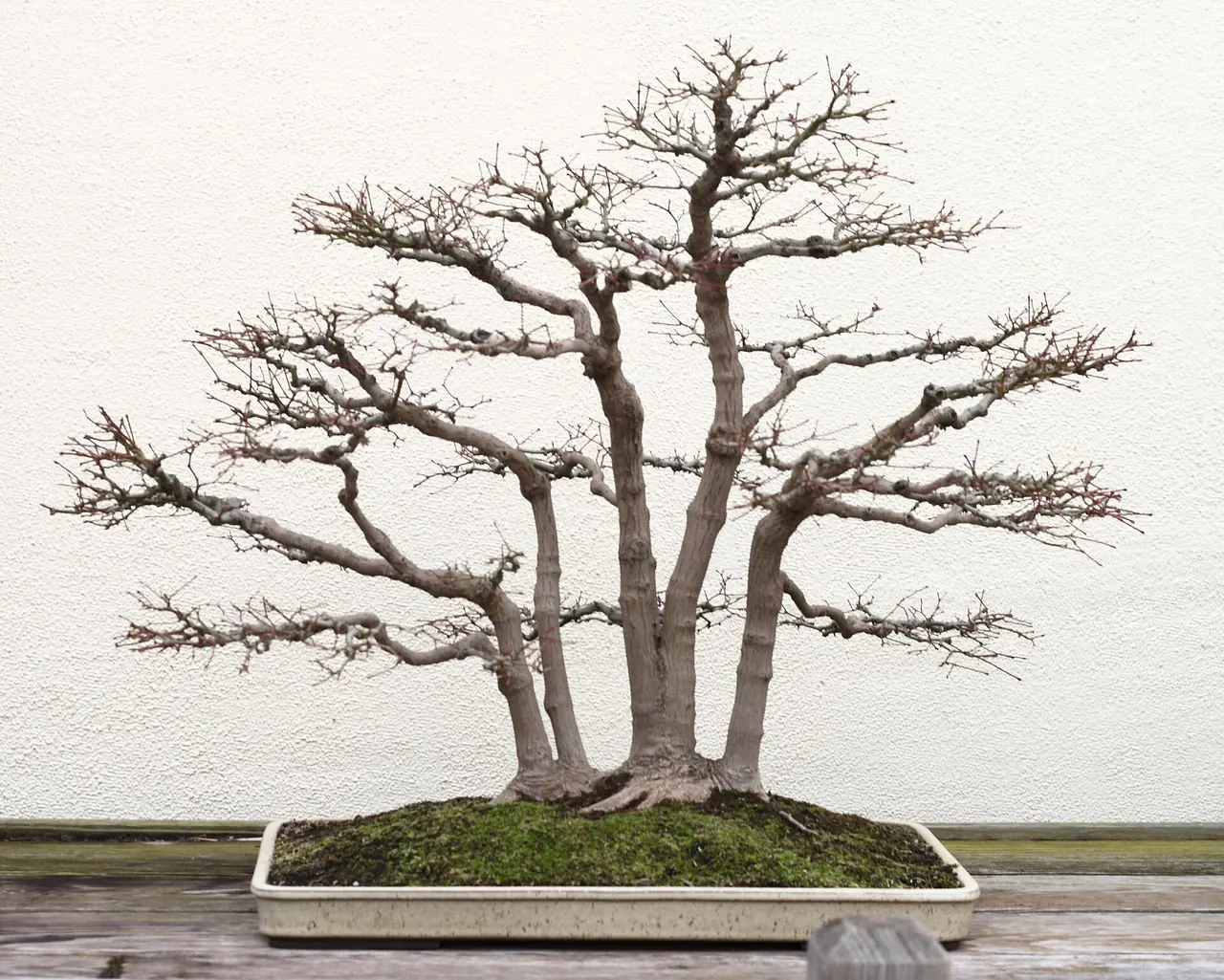
Maples bleed from cuts made between a few weeks after leaf drop and leaf-out, and growers differ on how much that harms the tree. Our recommendation, where growers differ, is small cuts in late winter only, leaving big cuts for another season. Many maple specialists prune at leaf drop, when sap flow has nearly stopped, but growers differ where autumns are cool and wet. Cut just above a node: maples bud reliably only at nodes, and growers report that a cut often dies back as far as the next node down.
The two recommendations do not clash: "small cuts only" is for branch work on trees in training and refined trees, while the trunk chop is made on a strong tree still developing in the ground or a big box; that is our reading of the two answers, not a rule from a source. For the trunk chop on a developing tree, we recommend late winter, before leaf-out, following Mirai; the bleeding will show, and growers differ on the season. Brent Walston writes that a chop before leaf-out gives "the most rapid development" of a new trunk section, and one made while leaves open should "probably never" happen.
Wiring without marks
Wire bare branches just after leaf fall or before the buds extend, or in late spring once new leaves harden. Avoid heavy bends in winter: they cause die-back the next spring. Use aluminium wire; thin, smooth maple bark marks quickly. Never let wire mark a maple, though growers differ on how much bite a tree can take. Leave it on for a few months, checking often for bite and removing it sooner if it cuts in; growers differ on set time. A light mark fades in a year or two; a deep one might never go.
Repotting
Repot early in spring, at bud swell or a little before it; Dupuich finds a maple takes more root work then than a month sooner or later. We follow Bjorholm in taking up to half the roots of a healthy maple, though growers differ. Once the leaves have opened, Harrington waits until the next year. Never repot in autumn without frost protection: new maple roots are damaged when the soil falls below about 20 to 28 °F. More in When to repot a bonsai.
Winter: protect the potted roots
In a pot the roots are the weak point: in one tested cultivar, mature roots died at about −9.4 °C (15 °F). The RHS notes that container trees need winter protection even where garden maples are fully hardy. We recommend moving a potted maple to a sheltered space or unheated garage below about −6 °C (20 °F), following Mirai, though growers differ on the threshold. Never winter it indoors: it needs the cold.
Common problems and mistakes
- Leaf scorch: brown, crisp edges; finely cut cultivars and weak or freshly repotted trees burn first. Scorched leaves do not recover that season, but lasting damage is rare. Instead, shade the tree before the heat.
- Bacterial blight in wet autumns: twigs blacken while dormant and buds fail to open; the bacterium enters wounds and is encouraged by wet, cool winters. Instead, where autumns are wet, Hagedorn suggests summer or a dry spring day for cuts, sterilised and sealed, though growers differ on autumn cuts.
- Dying inner twigs: shade inside the canopy kills them, so thin the outer leaves.
Where growers differ
Leaf removal. Where growers differ, we recommend partial leaf removal only. Growers differ: Scott Elser calls full defoliation "a bad idea" and Bjorholm warns of an unbalanced second flush, while Dupuich and Harrington fully defoliate strong trees, at most once a year.
Late-winter cuts. Where growers differ, we recommend small cuts only. Growers differ on bleeding: Harrington and Elser say it can badly weaken a tree, Iowa State Extension says it "does not harm the trees" (garden trees), and Mirai still recommends late winter.
Cuts at leaf drop. We make no recommendation: growers differ. Hagedorn (2023), Elser and Harrington prune at leaf drop, when cuts barely bleed; Hagedorn (2011) and the PNW Handbook differ, warning against it where winters are cool and wet, because of blight.
The trunk chop. We recommend late winter, before leaf-out, after Mirai. Growers differ: Harrington says autumn after leaf fall or midsummer, "Never prune during Spring"; Neil Padbury, in cool Victoria, Australia, chops from late spring to autumn and sees bleeding only from midwinter to leaf-out.
Wire. Where growers differ, we recommend a few months, checking often for bite, with no mark. Growers differ on set time: Harrington says deciduous branches can set in as little as two or three weeks of vigorous growth, Bonsai Empire gives 6 to 12 months, and Bjorholm expects maple wire to need removing within 1 to 2 months.
Nitrogen for young trees. No recommendation, because growers differ: Harrington and Bjorholm use high nitrogen, Bonsai Empire says avoid it, and Mirai uses a balanced organic feed.
Roots at repotting. We recommend up to half on a healthy tree (Bjorholm); growers differ, and Bonsai Empire's general limit is 30%.
Cold. We recommend protection below about −6 °C (Mirai); growers differ, with Bonsai Empire, Harrington and Walston at −10 °C and Hagedorn protecting many temperate trees below −2.8 °C.
Related
Sources
- Michael Hagedorn, Crataegus Bonsai: Pinching Japanese maples, Japanese maple fall prune, Read this if you grow Japanese maple; via Bonsai Bark: Cold weather bonsai
- Bjorn Bjorholm, Eisei-en: Japanese maple care
- Harry Harrington, bonsai4me: Japanese maple guide, Wiring, Partial defoliation
- Jonas Dupuich, Bonsai Tonight: Fall cutback, Defoliating a Japanese maple, Partial defoliation, Three repotting tips, Shade cloth, Major cuts on young maples
- Scott Elser, Bonsai Society of Portland: Mid-season pruning, Learning from the landscape, Maple notes
- Brent Walston, Evergreen Gardenworks: Japanese maples for bonsai, Developing large trunks, Fall repotting, Overwintering
- Bonsai Mirai: Japanese maple
- Bonsai Empire: Japanese maple, Wiring, Repotting
- Neil Padbury, Shibui Bonsai: AusBonsai forum, "How to get major backbudding on maples?" (2021; no link recorded in our research)
- Royal Horticultural Society: Acer leaf scorch, Japanese maples
- Extension services: Iowa State, sap from cuts, NC State, Acer palmatum, University of Tennessee, root-killing temperatures, PNW Handbook, bacterial blight
- Australian growers on southern-hemisphere seasons: Mirai forum thread, AusBonsai forum thread
Checked against our research on 2026-11-16.