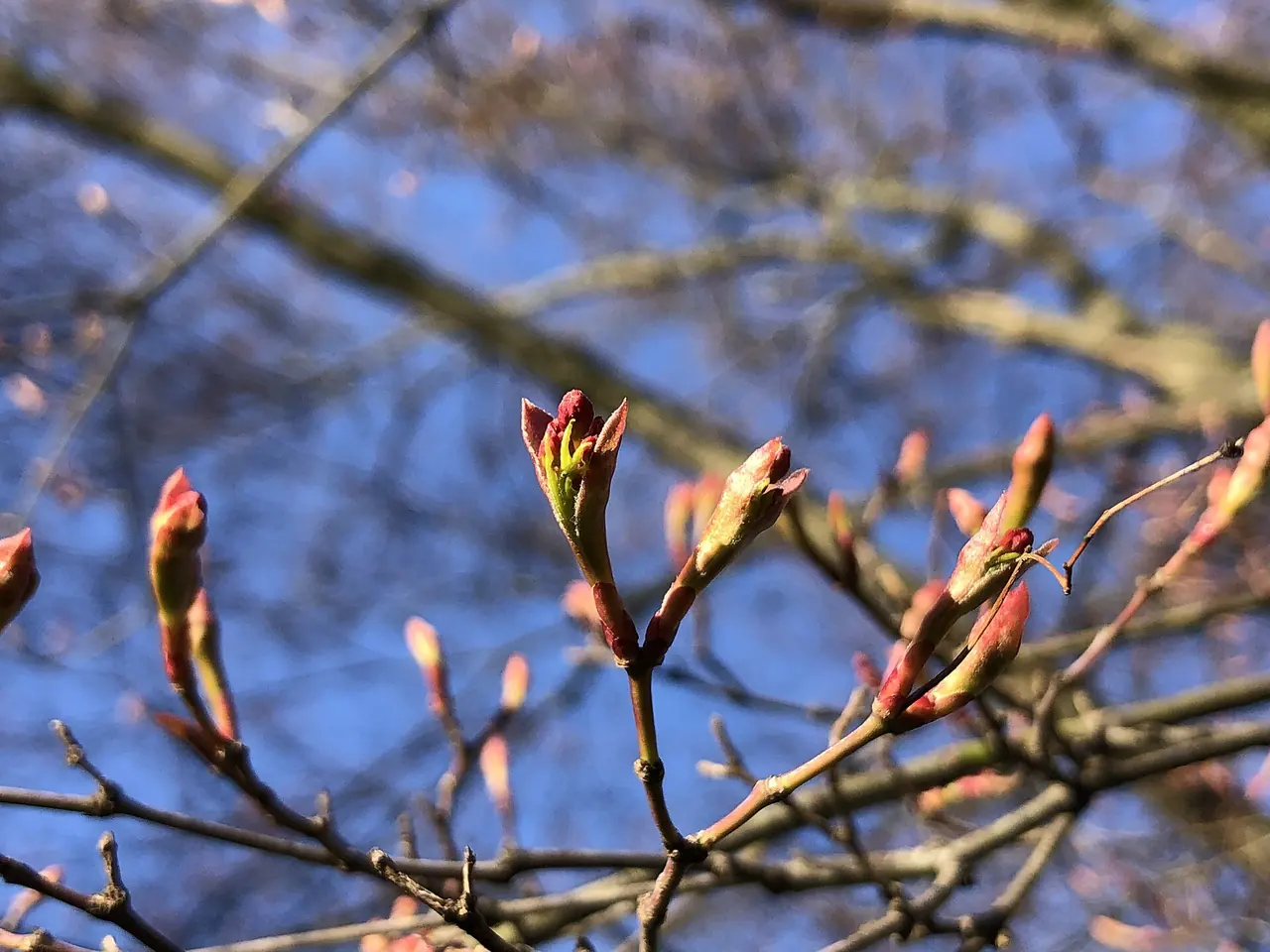
Repot when the roots have filled the pot or the soil has broken down, not on a schedule. The right moment is a tree stage: the buds swelling at the end of winter, when roots are waking. That stage comes in late winter in a mild climate and early spring where winters are cold, and in the southern hemisphere it comes in its own late winter or spring.
Signs a tree needs it
- Roots circling the pot when you check in early spring (Bonsai Empire).
- A sharp chopstick that will not enter the soil easily, in Michael Hagedorn's test.
- Old soil at the core, which Harry Harrington says will eventually cause root rot.
- Slow growth and yellowing despite feeding.
The stage, and what it means in your climate
At bud swell the buds enlarge and their scales loosen; Kigi Bonsai's black pine guide calls it "the main repotting window".
- Mild winters. The stage comes early; as Hagedorn puts it, "Spring in Lost [sic] Angeles is wintertime for most other places".
- Cold winters. The stage comes later: Walter Pall, writing about lifting trees, puts it later in the Alps and northern Europe than in central Europe. Jonas Dupuich warns that root work done before the tree wakes is slow to heal, which "can weaken trees exposed to hard freezes".
- Hot summers. No source gives a separate rule for hot-summer climates: Bjorn Bjorholm, whose guides probably date from hot-summer Tennessee, uses the same stage, repotting maples in early spring "just as the buds begin to swell".
- Southern hemisphere. A Melbourne grower repots pines in winter, "before major growth in spring", and Kigi Bonsai tells Australian growers to "use the tree's bud stage rather than a fixed September repot date".
Black pine against Japanese maple
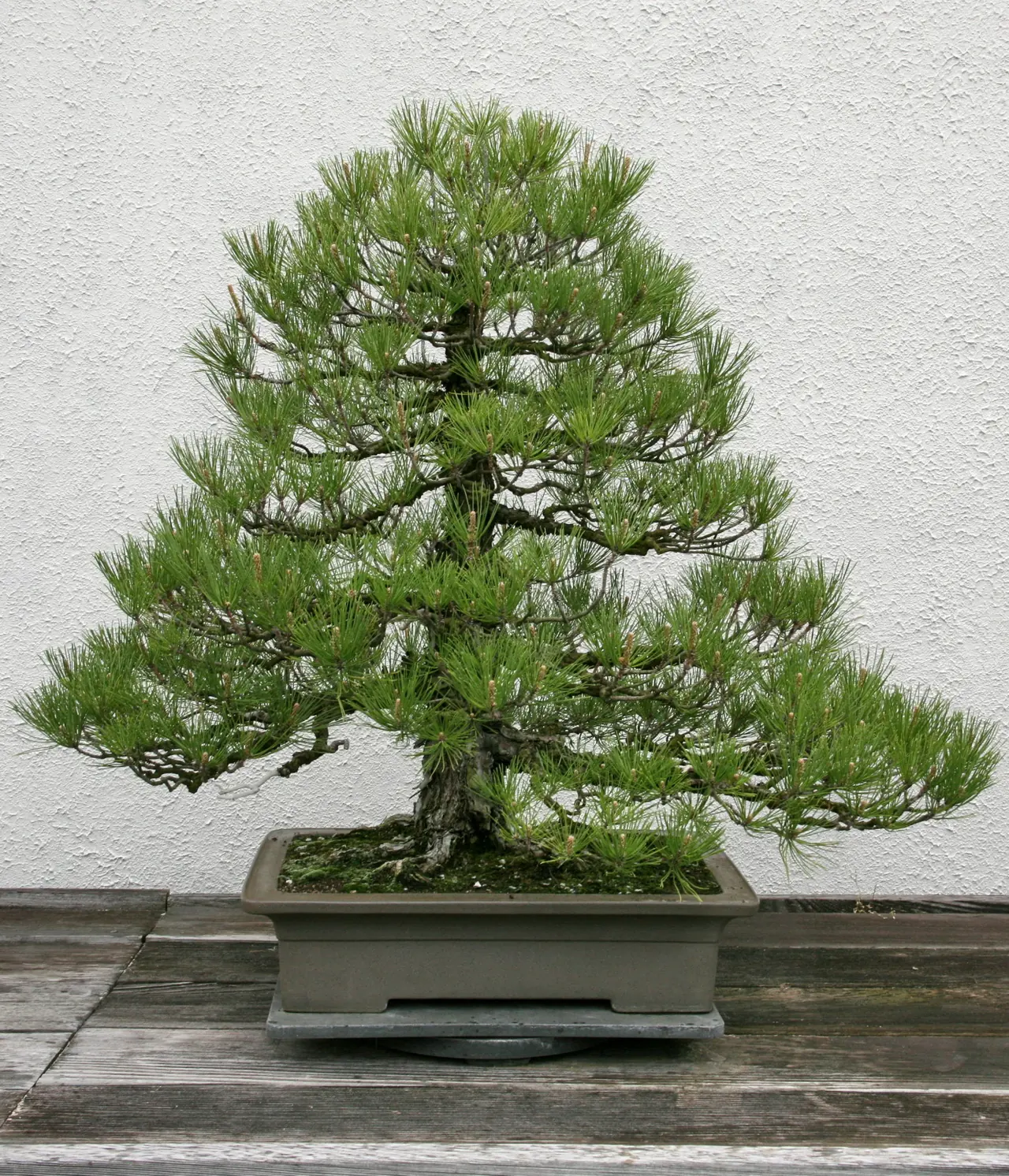
Black pine. Repot in spring, at bud swell or a little before it, where Mirai and Bjorholm agree; Dupuich would "rather repot early than several weeks too late". Never bare-root a pine: keep part of the old soil, which carries the root fungus pines depend on. Mirai removes no more than 50 to 60% of the roots; Bonsai Empire leaves at least half untouched. No candle cutting that year.
Japanese maple. Repot early in spring, at bud swell or a little before it, when Dupuich finds it takes more root work than a month sooner or later. We follow Bjorholm in taking up to half the roots of a healthy maple, though growers differ. Once the leaves have opened, Harrington waits a year.
Both. At every repotting, remove thick downward roots and crossing roots, and fan the rest out so the surface roots radiate evenly, none pointing at the viewer.
Aftercare
- Tie the tree in with wire so it cannot rock and break new roots.
- Water thoroughly until the soil is fully wet.
- Keep it out of sun and wind for about a week.
- Water a just-repotted pine less often, though growers differ (below).
- Feed after 3 weeks to about a month.
- Treat it as less hardy for six weeks, as Harrington does.
- Let it grow freely that year.
Autumn repotting, and its condition
Harrington prefers late summer to early autumn for pines in the mild UK, and Bonsai Empire allows it. It works only where daytime temperatures hold above about 50 °F for six to eight weeks before winter, because a hard freeze kills the new roots; new maple roots suffer once the soil drops under 20 to 28 °F. Hagedorn repots in autumn only "if you have protection from freezing weather".
Where growers differ
Black pine season. Where growers differ, we recommend spring, at bud swell or a little before it (Mirai, Bjorholm). Bonsai Empire, also on the spring side, repots "just after the buds begin to swell"; Harrington prefers late summer to early autumn.
Maple bud stage. We recommend bud swell or a little before it, though growers differ a little: Mirai says "before buds swell", Bjorholm "just as", and Harrington "as buds extend".
Maple roots. Where growers differ, we recommend up to half (Bjorholm); Bonsai Empire's general limit is 30%.
Watering a repotted pine. Where growers differ, we recommend watering less often: the new soil stays wet until roots grow into it. Dupuich's freshly repotted pines need water about half as often as those repotted the year before; Hagedorn warns the old root core can dry out while the new soil is still moist.
Common mistakes
- Repotting after the leaves open: wait a year.
- Leaving the tree untied: Harrington's juniper turned in a wind and lost roots on one side.
- Autumn repotting where winters freeze: repot at bud swell instead, or give frost protection.
Related
Sources
- Jonas Dupuich, Bonsai Tonight: Three repotting tips, Repotting a young black pine, Spring watering tips, Securing a bonsai in its pot, Feeding after repotting, Repotting a trident maple
- Michael Hagedorn, Crataegus Bonsai: Tips for repotting, Confusion over fall repotting, Lava woes
- Harry Harrington, bonsai4me: When to repot deciduous bonsai, Repotting part II, Bare-rooting, Pine guide, A dying juniper
- Bjorn Bjorholm, Eisei-en: Japanese maple care, Japanese pine care
- Bonsai Mirai: Japanese black pine, Repotting conifers, Japanese maple
- Bonsai Empire: Repotting, Black pine, Japanese maple
- Brent Walston, Evergreen Gardenworks: Fall repotting, Root pruning
- Walter Pall: Collecting trees from the wild
- Phoenix Bonsai Society: Repotting
- William Valavanis: Root pruning a trident maple
- Kigi Bonsai: Japanese black pine care in Australia
- Australian growers: AusBonsai forum thread
Checked against our research on 2026-11-16.