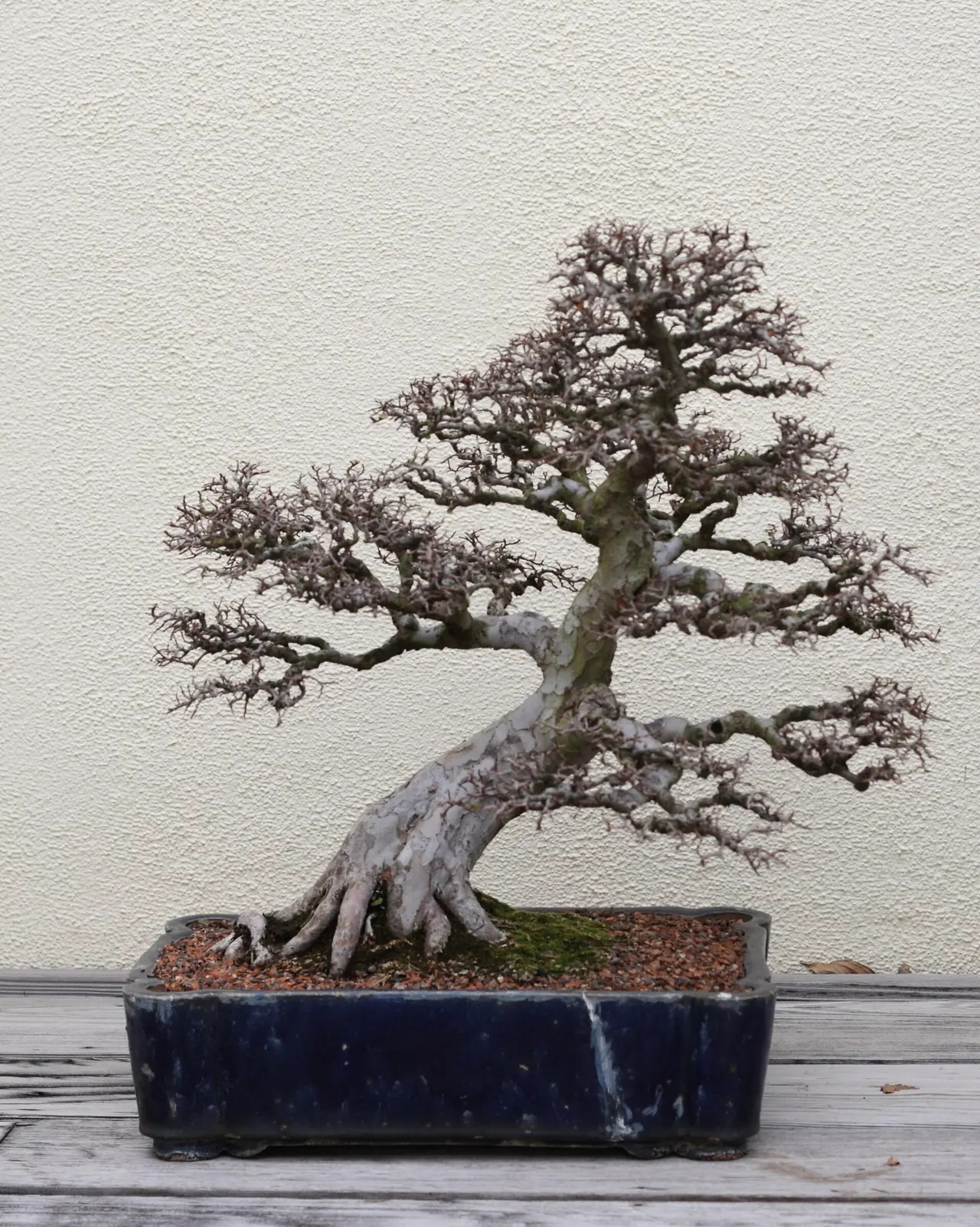
Scratch a little bark on a thin branch: green underneath means that part is alive, brown and dry means it is dead. Then bend a twig and look at the buds: supple twigs and swelling buds are good signs, brittle twigs that snap are bad ones. If the tree is alive, look at water and light before anything else; feeding, pruning and repotting come later, if at all.
Dead or alive: the two-minute check
- Scratch test. Scrape a small patch of bark on a thin shoot: living tissue is bright green, dead tissue tan to black. If the tips are dead, the RHS tests again on thicker wood; if most of the upper tree is brown beneath the bark, it has probably died.
- Bend a twig. Live twigs flex; dead ones are dry and brittle, and snap.
- Look at buds and bark. Plump or swelling buds are a good sign; the RHS adds that living shoots tend to have smooth, firm bark, dying ones flaking or wrinkled bark.
- If still unsure, look at the roots. Hagedorn describes healthy roots as "blonde to reddish brown" and rotten ones as black, grey or dark brown, squishy and smelly.
- Think about the season. A deciduous tree kept outdoors is bare in winter, and Bonsai Empire warns that many trees that look dead are only stressed or dormant. A Chinese elm may drop its leaves in a cold winter; while its twigs stay flexible and green under the bark, it is healthy.
Green is not proof of life
A juniper can keep its normal colour for weeks or even months after its roots have died, Harrington warns, so a green juniper or pine proves nothing on its own. Dupuich describes a shimpaku that made no spring growth, held its colour into early summer in his northern California garden, then yellowed over a few weeks; nearly all its roots had died. On any conifer, check the bark and the roots, not the colour.
The symptom key
How fast did it happen, and which leaves? Old, inner leaves going first point to nitrogen, magnesium or normal ageing; the youngest leaves going first point to iron or manganese.
| What you see | Likely causes | The check that tells them apart | What to do |
|---|---|---|---|
| Yellow leaves, slowly, over weeks | Overwatering and root rot; too little light indoors; hunger | Soil still damp at watering time, dark soft roots: rot. Far from the window, long thin shoots: light. Oldest leaves evenly pale, short shoots, long unfed: nitrogen | Let a wet tree dry a little and check drainage; move to the brightest window or add a lamp; feed only once it grows again |
| Yellow leaves, fast, then dry within days | A missed watering or a hot spell | Pot feels light, soil dry; broadleaf trees show it within hours or days, conifers much more slowly | Water thoroughly, twice if the soil is hard; Dupuich soaks a dry pot in a tub |
| Youngest leaves yellow between green veins | Iron shortage from alkaline water or soil; manganese looks the same | New growth first; a lime-hating species or hard water | Rain water or acidified water, or a chelated iron spray |
| Brown tips or edges | Salt from heavy feeding; drought; wind or sun scorch; frost | White crust on the soil: salt. After a dry spell: drought. Worst on the windward or sunny side: scorch. Pale patches between veins after a cold night: frost | Salt: stop feeding and run water slowly through the soil for several minutes. Scorch: shelter from midday sun and wind. Frost: wait, as the RHS says it may reshoot lower down |
| Sudden leaf drop | A missed watering; a move, draught or change of light (ficus, serissa, Fukien tea); cold; an elm dried out then flooded, or sprayed | Did the soil dry out lately? Was the tree just bought, moved, or set by a cold window? | Water if dry, and keep it in one bright, warm place; a Florida production guide gives a ficus coming indoors about four weeks with no move, pruning, repotting or feeding |
| Conifer needles browning | Normal shedding; root death; shade inside dense pads; spider mite | Old inner needles yellowing evenly, tips green: normal. No spring growth, then the whole tree or one side going: roots. Brown only inside the pads: shade. Speckling and webbing: mites. Bronze in winter: frost colour, green again in spring | Normal: nothing. Roots: the rescue steps below. Shade: thin the pads. Mites: Dupuich treats at ten or more on a white-paper tap test |
| Wilting while the soil is wet | Root rot: the roots can no longer take up water | Leaves stay limp after watering; black, soft, smelly roots. A maple wilting on one side in hot weather, with dark streaks under the bark, suggests verticillium wilt | Root work (step 6); verticillium has no chemical cure |
| White powder on the leaves | Powdery mildew | It wipes off; not fluffy wax in leaf joints (mealybug) | Remove infected leaves, improve air flow, water evenly |
| Spots | Fungal leaf spot; anthracnose on a maple in a cool, wet spring | Fungal spots are brown with yellow halos and, under a magnifier, tiny black dots | Pick off spotted leaves; Wisconsin Extension calls maple anthracnose cosmetic |
| Sticky, shiny leaves | Honeydew from scale, aphids or mealybugs | Shell-like bumps on stems, clusters on soft tips, white wax in leaf joints | Treat the pest you find |
| Fine webbing, pale speckled leaves | Spider mites | Tap a branch over white paper and watch for moving specks | Treat, then find the weakness behind them: Harrington judged mites on a dying juniper a result of poor health, not the cause |
Ten rescue steps
- Check it is alive, as above.
- Find out what it is, and whether it belongs indoors: Bonsai Empire warns that an outdoor tree kept inside yellows and slowly dies. See our gift bonsai guide.
- Check water and light first, pushing a finger below the surface: Dupuich has seen the top of the soil darken after watering while the rootball beneath stayed dry.
- Stop feeding until it grows strongly again, in most bonsai sources' view; growers differ (below).
- Fix drainage and watering. If the soil stays wet, Dupuich moves the tree under cover or props one end of the pot on a board so the soil holds less water. Rot often begins with roots drying out, so Hagedorn speaks of "moderating" the watering rather than simply watering less.
- Leave the pot alone unless the roots are rotting; growers differ here too.
- Shelter it from strong wind and intense sun after any root work, as Harrington advises.
- Do no other work: no leaf removal, candle cutting or wiring on a weak tree, and Bonsai Empire keeps big changes to once a year.
- Look for pests last. With no sign of them, Bonsai Empire says pests are very unlikely to cause sudden leaf drop or yellowing.
- Cut out dead parts later. Iowa State Extension waits for new growth before removing browned conifer tips, as buds may survive there.
As Bonsai Empire puts it, "There is no magical cure": only the right care for the species.
How long recovery takes
- Mild stress, such as a short drought or a move: new leaves a few weeks after the tree stabilises, says Bonsai Empire.
- Root damage or long overwatering: a growing season or longer, and some lost branches may not return.
- Ficus after losing its leaves: 3 to 6 weeks for Harrington, 4 to 6 for Bonsai Direct.
- A tree tired by too much work: one growing season, and "three years for a really tired old tree", in Hagedorn's words.
- Harrington's juniper, which lost over 70% of its growth: dieback in late winter in his UK garden, much healthier by early summer.
Our research found no recovery times by cause for elm, maple, Fukien tea, serissa or jade.
When it is too late
The tree cannot be saved once the roots have dried out completely, or once every root has rotted. Brittle branches with brown, dry wood under the bark throughout, with dark, soft roots, mean it is dead. Pine wilt is fatal, and Bonsai Empire says juniper rust "cannot be cured". But Bonsai Empire says recovery can still happen while the trunk and some branches live, and the RHS gives a doubtful plant "a few months or until spring".
Where growers differ
Feeding a sick tree. Growers differ, with no recommended way. Bonsai Empire and PenJing8 stop feeding until healthy growth returns; Bonsai Empire warns that "Fertilising a stressed tree can worsen the problem". The RHS, writing about wind-scorched garden evergreens, feeds in spring to help recovery. Harrington drenches weak trees with a rooting product every 2 to 3 weeks for a year.
Repotting a sick tree. Growers differ, with no recommended way. Bonsai Empire does not repot at once, moving the tree into proper soil once it has recovered. Hagedorn and PenJing8, when roots are rotting, cut back to healthy tissue and repot in airier soil. Harrington picks out broken-down soil with a chopstick without disturbing live roots, expecting recovery "over the following growing seasons".
Light during recovery. Growers differ, with no recommended way. Bonsai Empire wants "a stable location with good light"; Harrington shades weak trees from leaf-burst for the rest of the season, and after root work.
Misting. For maples, our recommendation is not to mist, because it can bring fungal disease and scorch leaves in full sun; use shade cloth or semi-shade instead. Bjorholm agrees; Dupuich's heat-wave advice is to mist often. For other trees growers differ, with no recommended way: Bonsai Empire mists indoor trees a few times a day, and a Japanese guide mists in heated winter rooms. NC State Extension finds misting not useful, as it raises humidity only briefly, and South Dakota State Extension advises against misting a plant with anthracnose.
Whether a move makes a ficus drop its leaves. Growers differ; our gift bonsai guide sets out who says what.
Hard water. Growers differ, with no recommended way: Dupuich, Harrington and Bonsai Empire acidify alkaline water, while Pall waters everything with very hard water and reports no harm.
Common mistakes
- Feeding a struggling tree to "help" it: check water and light first.
- Throwing out a bare tree in winter: do the scratch test first.
Related
- Got a bonsai as a gift? What to do first
- Japanese black pine care, season by season: yellow needles and root rot.
- Japanese maple guide
Sources
- Bonsai Empire: Troubleshooting: falling or yellow leaves, Help! My bonsai is dying, Indoor bonsai, Ficus, Chinese elm
- Bonsai Direct: Leaf drop on my bonsai
- Jonas Dupuich, Bonsai Tonight: How to tell when something is wrong, Root rot in black and red pine, Identifying weak roots by checking the foliage, Lowering the pH of your water, Heat waves
- Michael Hagedorn, Crataegus Bonsai: On root rot, When to let a tree run
- Harry Harrington, bonsai4me: Juniper guide, A dying juniper, Weak and newly collected trees, Repotting and root pruning
- Bjorn Bjorholm, Eisei-en: Japanese maple care guide
- Walter Pall: On water and soil, AusBonsai forum
- PenJing8: Why bonsai leaves turn yellow, Elm leaves yellowing and dropping
- 盆栽コレクション (Bonsai Collection, Japan): Choosing bonsai for indoors
- RHS: Why has my tree or shrub died?, Brown leaves on woody plants, Wind scorch, Frost damage
- Extension services: NC State, plants grown in containers, South Dakota State, houseplant troubleshooting, University of Maryland, nutrient deficiency, University of Maryland, fungal leaf spots, Wisconsin, anthracnose, Clemson, leaf and needle drop, Iowa State, browning on conifers, UF/IFAS, frozen garden recovery, UF/IFAS, interiorscape ficus