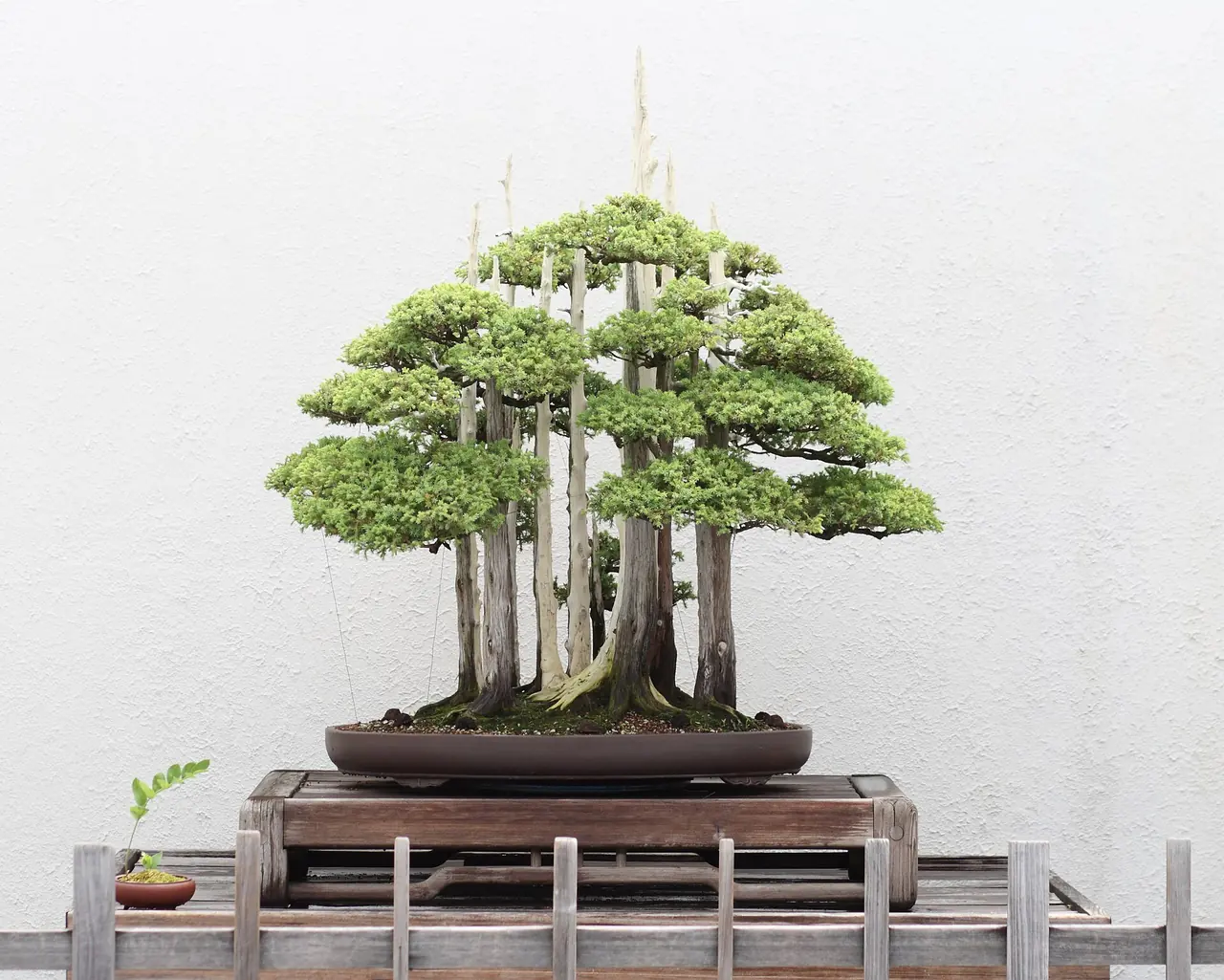
A bonsai's style is named mainly by the line of its trunk: upright, leaning, or falling over the edge of the pot. The common styles have Japanese names, but every major source calls them guides rather than laws, and a tree that shows several is named for its strongest feature. Size classes go by height, and each show draws the lines a little differently, though shohin, the small class, is usually up to about 20 cm.
The styles, and what each is trying to show
Formal upright (chokkan, 直幹)
The trunk is straight, upright and tapering, with its top directly over the base. Branches are thickest and longest low down and shorter toward the top, so the outline is a triangle, though Harry Harrington says not a strictly symmetrical one. The Omiya Bonsai Art Museum's guide notes that this style and the informal upright are often seen on pines. Brent Walston's list puts uprights without much movement in rectangular pots.
Informal upright (moyogi, 模様木)
The trunk curves, roughly in an S, but its top still comes back over the base. Branches grow from the outside of the bends, and Walston wants the curves closer together toward the top, warning that too many S-curves become tiresome. Harrington calls it suitable for most species: pines usually show flat branches with clear clouds of foliage, while maples should have rising branches and no hard-edged pads. Oval or round pots suit it.
Slanting (shakan, 斜幹)
The trunk leaves the soil at an angle and its top sits to one side of the base; Bonsai Empire, the only source with a figure, gives about 60 to 80 degrees to the ground. The first branch grows away from the lean, which Bonsai Empire says gives the tree visual balance, and the roots are strongest on the side opposite the lean. Harrington plants a tree leaning to the right left of centre, so its weight sits over the middle of the pot.
Cascade (kengai, 懸崖) and semi-cascade (han-kengai, 半懸崖)
The characters of kengai mean a cliff. The trunk rises a little, then bends down, with a crown usually above the rim. In most English-language sources a full cascade's tip falls below the base of the pot, and a semi-cascade ends between the rim and the base. Cascades go in deep pots or on tall stands, and Brooklyn Botanic Garden says the tree must never touch the surface it stands on. On a black pine, Michael Hagedorn warns that the low, cascading part is already the weakest part of the tree.
Windswept (fukinagashi, 吹き流し)
The tree looks as if a strong wind has always blown from one side; the Omiya guide says the style "conjures up a tree battling a strong wind". Bonsai Empire lets branches grow on every side and then bends them all one way. Harrington calls the usual version, every branch on one side "flung out", a cliché that spoils the form.
Literati (bunjingi, 文人木)
John Naka, as Hagedorn quotes him, explains that "Bunjin means literary man". A long, slender, often twisting trunk is the main feature, with a few branches high up, carrying just enough foliage to keep the tree alive (Harrington). It breaks the usual rule of a first branch about a third of the way up on purpose, and Bonsai Empire puts it in small round pots. Naka wrote that the shape may suggest struggle, but the tree itself should be healthy. Harrington's guides allow it for pines but not for Japanese maple.
Broom (hokidachi, 箒立ち)
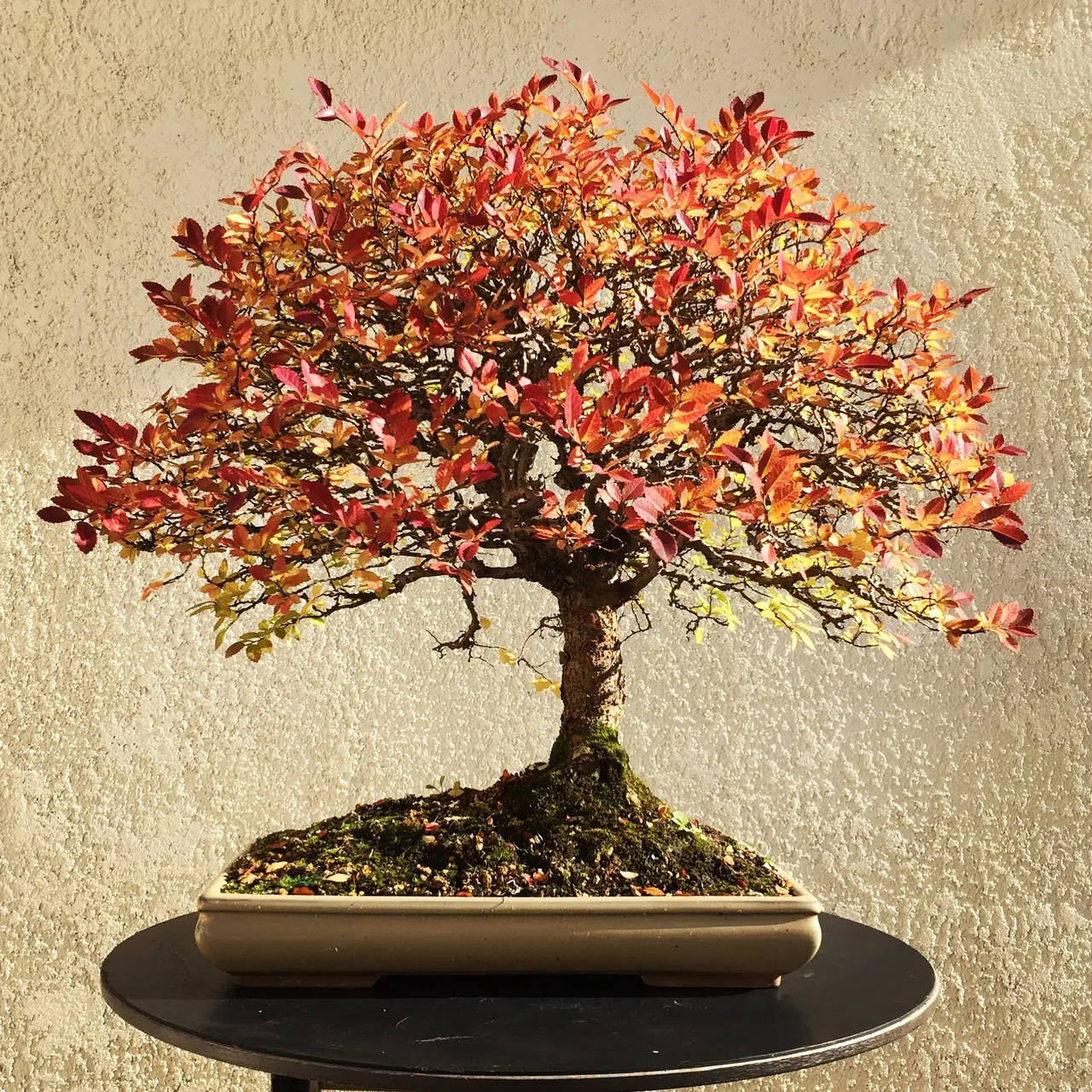
A straight trunk divides about a third of the way up into branches that fan upward, under a ball or dome of fine twigs. Harrington recommends it for fine-branching trees such as elm and zelkova, finds all deciduous trees suitable, and rules it out for conifers, pines among them.
Other styles
- Twin trunk (sokan, 双幹): two trunks from one root, one taller and thicker, sharing a crown.
- Multi-trunk and clump (sankan, 三幹, for three; kabudachi, 株立ち): several trunks from one root, usually an odd number, one dominant.
- Forest (yose-ue, 寄せ植え): many separate trees, usually an odd number, of different heights, set so no three stand in a line (Brooklyn Botanic Garden).
- Raft (ikadabuki, 筏吹き): a tree laid on its side whose branches grow up as trunks.
- Root-over-rock (sekijoju) and clinging to rock (ishizuki, 石付): roots that cross a rock into the pot's soil, or live in soil held by the rock itself.
- Exposed root (neagari, 根上り): roots standing clear of the soil, which Wikipedia says can reach a half to two thirds of the tree's height.
- Driftwood (sharimiki): much of the trunk bare deadwood, with at least one living strip joining roots to leaves.
Size classes
The sources say openly that they disagree. William Valavanis, reporting from Japan's Gafu-ten show, writes that "each individual bonsai exhibition in Japan has their own size categories", though shohin are "pretty standard at 20cm". Bonsai Empire says the classes began with the number of people needed to lift the tree.
| Where | Classes by height | Source |
|---|---|---|
| Nippon Bonsai Taikan-ten (as bonsai4me lists it) | mame under 7 cm; shohin up to 20; kifu 20 to 40; chu 40 to 60; dai over 60 | |
| Gafu-ten 2020, Kyoto (small trees only) | mini below 10 cm and below 7 cm; kifu 21 to 35; chuhin 35 to 45 | |
| Pacific Bonsai Expo, USA | shohin under 8 in; medium 8 to 18 in; large over 18 in | |
| Swindon winter show, UK | mame about 10 cm; shohin about 20; chuhin about 45 at most | |
| A Singapore show, 2024 | small below 30 cm; medium below 60; large below 100 | |
| Wikipedia and Bonsai Empire, general lists | mame 5 to 15 cm; shohin 13 to 20; komono 15 to 25, so the classes overlap |
How the height is taken differs too. Gafu-ten measures from the pot's top edge up to the highest leaves; the Pacific Bonsai Expo measures from the pot's lip and lets jin rise past the medium limit; Swindon measures from the soil. Height is not the only test: a British Shohin Association committee member, in a blog comment, describes a maple within the limit that was judged too "heavy" to class as kifu. Smaller trees are read more loosely: Bonsai Empire says that as trees shrink they show less detail and become more abstract. At Gafu-ten literati may be taller than 20 cm, but are expected to look delicate (Jonas Dupuich).
How a judge reads style
- Branches must fit the style. A Singapore show's judging form asks whether the branches "logically coincide with the style and the trunk movement".
- The trunk leads. One California club form gives the trunk 10 of 30 points, and the Pacific Bonsai Expo asks judges whether the movement is "extraordinary for the species or style".
- Faults are read against the style: branches from the inside of a bend, branches pointing at the viewer below the top third, two branches at one height, or a trunk thicker higher up than at its base.
- Each species is judged as itself: Dupuich looks at the bark on pines and at branch refinement and density on beech.
- Few winners fit every rule. Wikipedia notes that even highly regarded trees rarely meet every rule for their style.
Where growers and traditions differ
Cascade or semi-cascade. Growers differ on where one ends: most English sources draw the line at the base of the pot, Japanese Wikipedia and the Toronto Bonsai Society at the rim, and the Bonsai Learning Center by overall impression.
The first branch. Growers differ: Bonsai Empire starts a formal upright's branches at about a quarter of the height, Walston at about a third, and Harrington at a third to a half.
Japanese maple as formal upright or cascade. Growers differ: Harrington's forms article rules deciduous trees out of formal upright and Wikipedia says they are not made into cascades, but Harrington's maple guide allows every form except literati.
Style or approach. Growers differ on what a style is: Harrington, following Walter Pall, treats windswept as a manner laid over a form, and the Bonsai Learning Center calls literati an approach more than a shape.
The shohin limit. Growers differ: 20 cm at Gafu-ten and Taikan-ten, 8 inches at the Pacific Bonsai Expo, and under 25 cm on Bonsai Empire's shohin page.
Other traditions. Chinese penjing does not use the Japanese list; Robert Baran lists six basic Chinese forms, among them the straight, slanting and curved trunk, a cliff-hanging form and the forest.
How strictly to follow the rules. Walston, whose list is the most copied, says his rules "are not cast in stone"; Pall argues that naturalistic trees should be judged as such, and the Artisans Cup rubric accepts trees that look like trees in nature and trees that look like bonsai as "equally as valid".
Common mistakes
- A branch from the inside of a curve on an informal upright: keep branches on the outside of the bends.
- Every branch flung to one side on a windswept tree: Bonsai Empire grows them all round and then bends them one way.
- A broom on a pine: Harrington keeps the broom for deciduous trees.
- A cascade that touches its stand: set it on a stand tall enough to clear it.
Related
Sources
- Wikipedia: Bonsai styles, Bonsai, Bonsai aesthetics; Japanese Wikipedia: 盆栽
- Bonsai Empire: Bonsai styles, What is bonsai, Shohin
- Harry Harrington, bonsai4me: The basic forms of bonsai, A guide to bonsai critique, Japanese bonsai terms, Pine guide, Japanese maple guide
- Brent Walston, Evergreen Gardenworks: The "Rules" of Bonsai
- Brooklyn Botanic Garden (Pauline F. Muth): Bonsai styles; Virginia Cooperative Extension: The art of bonsai; Longwood Gardens: The beauty of bonsai styles
- Japan Tourism Agency, for the Omiya Bonsai Art Museum: Shapes of bonsai
- Michael Hagedorn, Crataegus Bonsai: Bunjin, part I (quoting John Naka), When do we turn trees
- Bonsai Learning Center: Cascade and semi-cascade, Literati; Toronto Bonsai Society: Bonsai lexicon
- Robert J. Baran, Magical Miniature Landscapes: Japanese styles of bonsai, Chinese schools of penjing
- William N. Valavanis: 45th Gafu-ten, part 1
- Jonas Dupuich, Bonsai Tonight: Shohin judging categories at Gafu-ten, Judging categories at the Pacific Bonsai Expo, Evaluating bonsai, Conifers vs deciduous bonsai
- Pacific Bonsai Expo: Instructions for judges
- Swindon & District Bonsai Club: Winter image show 2018
- Bonsai Inc x Aquatic & Garden Asia 2024: Judging form, Rules
- Bonsai Eejit: Bonsai sizes
- Walter Pall: Styles and forms; The Artisans Cup 2015: Judging rubric