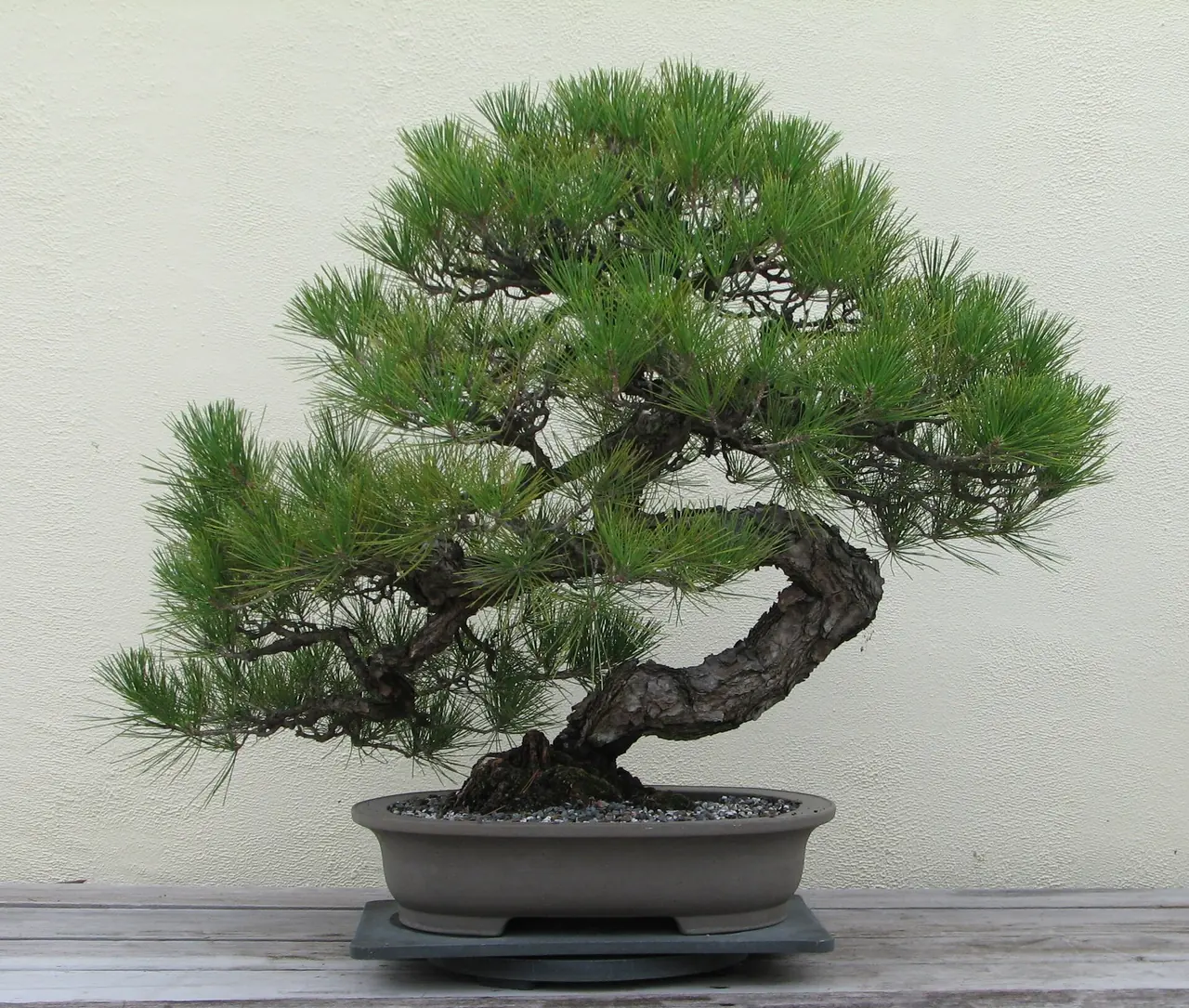
Japanese black pine wants full sun, free-draining soil and a year planned around its candles, the new spring shoots. A strong, refined tree is fed well in spring, has its spring shoots cut once they mature, and then grows a second, shorter flush in summer. Autumn is for thinning shoots, pulling old needles and wiring.
What the tree is
Japanese black pine (Pinus thunbergii) carries its needles in pairs, 6 to 12 cm long on an untrained tree, and keeps each set for 3 to 4 years. In the wild it grows on sea cliffs, where, in Walston's words, it puts up with "gale winds and salt spray". Its heavy trunks, deeply furrowed bark and dense foliage have earned it the name "king of bonsai".
A vigorous black pine has the strength for two growth cycles a year, so its whole spring shoot can be cut; single-flush pines such as white and Scots pine are only pinched in spring.
The year, by tree stage
Black pine follows stages, not dates, so each step falls earlier in a warm garden and later in a cool one. Growers in the southern hemisphere use the same stages in their own seasons; one Australian guide advises reading "the tree's bud stage rather than a fixed September repot date".
- Roots wake and buds swell (late winter in a mild climate, early spring where winters are longer): feeding of refined trees starts as the roots become active, and the repotting window opens.
- Candles extend (spring): the new shoots lengthen before their needles open, and trees that will be candle-cut are fed heavily.
- The first flush matures (start of summer in a cool climate, early summer in a mild one, midsummer in a hot one): needles open and the shoots firm up; this is when a strong, refined tree has its candles cut.
- The second flush emerges (summer): new buds show around each cut within 7 to 12 days, and the summer shoots are growing well by about five weeks.
- The second flush hardens (late summer into autumn): in Dupuich's mild Bay Area garden the summer needles mature in early autumn.
- Autumn: thin crowded shoots, pull old needles, then wire.
- Winter: the tree is relatively dormant, and potted trees need protection from hard cold.
Placement and sun
- Give it your sunniest spot; it takes full sun all day.
- None of our sources puts black pine under shade cloth, and Mirai says shade should be avoided.
- In shade the needles grow longer and shaded branches die back.
- It copes with heat: Mirai reports it tolerates more than 38 °C, and up to 43 °C in a deeper pot.
Watering and feeding
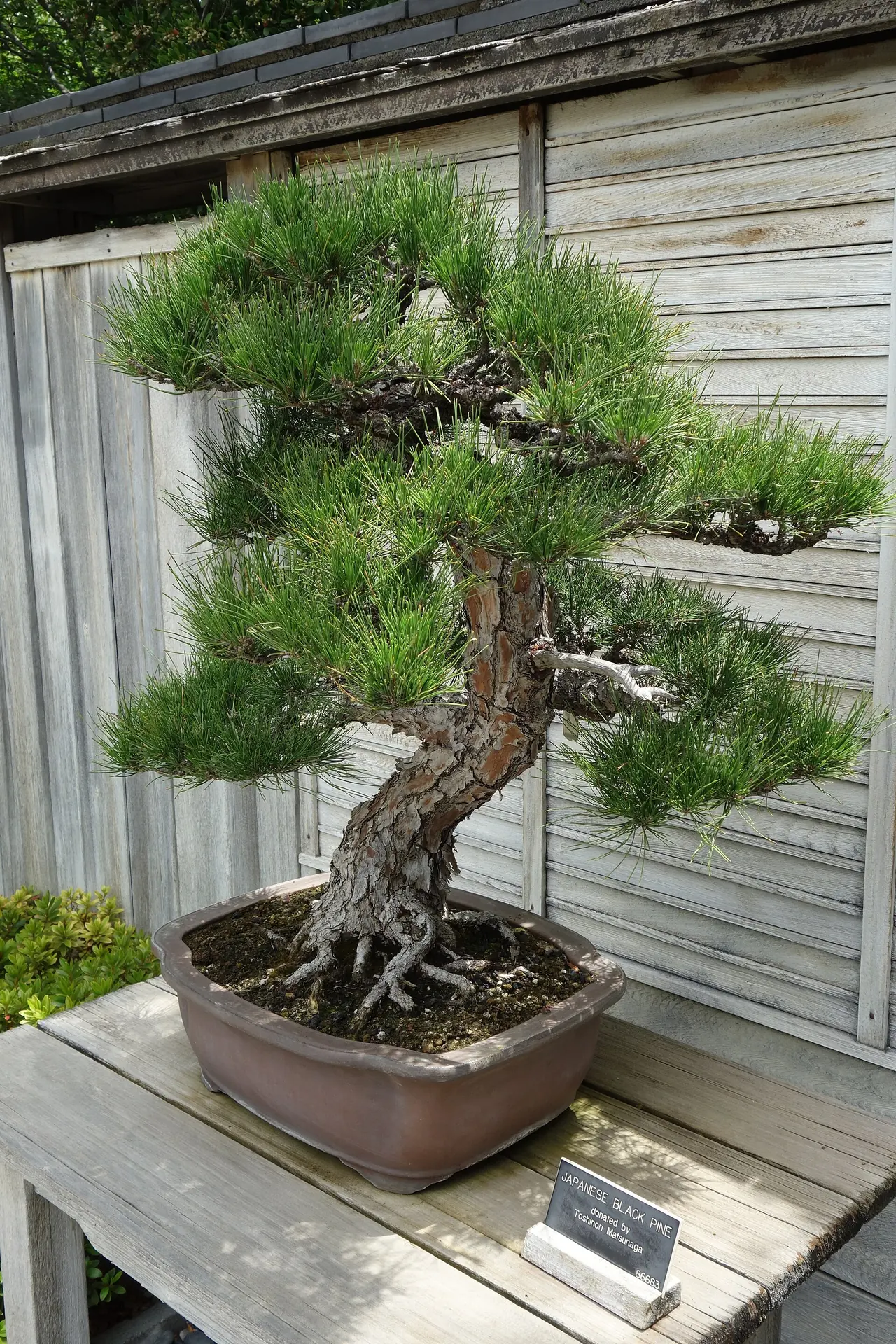
Watering. Let the soil partly dry, then water thoroughly. In warm summer weather Dupuich waters pines in colanders every one to two days, and field-grown pines in large containers every four to five days. Extra water lengthens needles much as extra feed does, so Bonsai Empire advises keeping heavy rain off while the second flush grows.
Feeding: Build or Refine. Choose by what the tree needs next.
- Build (trunk still thickening): feed heavily from spring candle growth until dormancy, and do not cut candles, because cutting slows thickening.
- Refine (a finished, compact tree): feed heavily from when the roots wake until the candle cut, so the tree has the strength for a second flush.
- Feeding stops at the cut so the new needles stay short; growers differ on when to restart, and we recommend waiting until the second flush has hardened.
Candle cutting, in brief
On a strong, healthy, refined tree the whole spring shoot is cut once the first flush has matured, and the tree answers with a second flush of shorter shoots and shorter needles. Weak trees, trees repotted that year and trees still building a trunk are left uncut. Where summers are cool or short the second flush is weak or erratic, and Hagedorn suggests growing such trees with one flush, or cutting every other year. Full method: Decandling black pine.
Autumn shoot selection
- Once the summer shoots have hardened, in mid to late autumn, each cluster is cut down to two; growers differ on which two to keep (see below).
- On a thin, developing area keep three and reduce to two later; on a very dense or old tree keep one.
- Pull last year's needles, leaving more on weak shoots, until the background shows through; we recommend doing this once the second flush has hardened, which Mirai (Oregon, mild summers) and Bjorholm (Tennessee, hot summers) both put in late summer to early autumn, though growers differ.
- Leave a few old needles on bare stretches of branch: they raise the chance of a back bud.
- In a mild-winter garden the work can run into winter; elsewhere, stop about a month before temperatures regularly drop below freezing, so buds can set for spring.
Wiring season
We recommend wiring from late summer through autumn, once summer growth has hardened, as Bjorholm does in a hot-summer climate, advising against wiring pines from spring through summer; growers differ. Dupuich wires from when summer growth hardens in autumn until the buds grow in spring, protecting wired pines in frost. Dupuich also wires straight after candle cutting, before the summer buds show, since summer shoots snap once they are out; growers differ on this (see below). Copper suits pines, at about a third of the branch's thickness. Wire sets a young pine's branch in 3 to 12 months for Dupuich, 6 to 7 months for the Buffalo Bonsai Society.
Repotting
- We recommend spring, just before or at bud swell, as new white root tips appear: late winter in a mild climate, early spring where winters are longer; growers differ (see below).
- Mirai removes no more than 50 to 60% of the roots and never bare-roots; Bonsai Empire leaves at least half the root mass untouched.
- Keep some old soil: it carries the root fungus pines rely on.
- Resume feeding 3 weeks to about a month after the repot, and skip candle cutting that year.
Winter protection
Planted in the ground it survives USDA zone 5a winters (−29 to −26 °C), but roots in a pot are far less hardy than the top. We recommend moving a potted tree into an unheated garage or cold frame below about −9 °C, though growers differ. One Oregon State University nursery table records potted black pine roots damaged at about −15 °C, and Hagedorn separately reports that a black pine on its own roots can die below about −11 °C. When the rootball is frozen, keep the tree out of drying wind, and do not let the roots stay frozen for long.
Common problems
- Old inner needles yellow in late summer to early autumn while this year's stay green: normal ageing, nothing to do.
- New needles yellow near the base but green at the tips: Dupuich reads this as overwatering; let the soil dry further between waterings.
- The whole tree yellows in the growing season: wet, airless soil can cause it, and Dupuich adds under-feeding and poor water.
- Low and inner branches weaken: they are shaded; give more sun and thin the dense top.
- Needles too long: candles cut too early, or too much water or feed during the second flush.
- Foliage turns dull green, then yellow, then brown: possibly pine wilt nematode, which often kills a tree infected in spring by late summer to early autumn; only a lab test can confirm it.
Where growers differ
Which two autumn shoots to keep. Our recommendation, where growers differ: keep the two medium shoots and cut the strongest and the weakest, as Hagedorn and the Buffalo Bonsai Society do. Other growers differ: Dupuich keeps two of equal strength opposite each other, and Walston keeps the horizontal pair.
When feeding restarts after candle cutting. Our recommendation, where growers differ: once the second flush has hardened, as Bonsai Empire advises. Other growers differ: Dupuich restarts after about four weeks, Hagedorn after 4 to 6 weeks, and the Buffalo Bonsai Society when the second buds begin to push.
When to repot. The recommended way, where growers differ, is the experts' default: spring, just before or at bud swell (Mirai, Bjorholm, Dupuich). Harrington differs, preferring late summer to early autumn.
When to pull old needles. The recommended way, where growers differ, is the experts' default: late summer to early autumn, after the second flush has hardened (Mirai, Bjorholm). Other growers differ: Dupuich plucks through autumn and winter until the candles lengthen, while Peter Tea and Bonsai Tree in South Africa prefer early spring.
Watering after repotting. Our recommendation, where growers differ: water less often, as Dupuich does, since the new soil stays wet. Hagedorn differs, warning that the old root core can dry out faster than expected and need water while the new soil is still moist.
How cold is too cold. Our recommendation, where growers differ: under cover below about −9 °C, as Lowcountry Bonsai advises. Others differ: Mirai wraps the pot below about −4 °C, and Dupuich protects when lows regularly fall below −2 °C.
When to make a large cut. Our recommendation, where growers differ, follows Bjorholm: once the second flush has hardened, which is late summer to mid-autumn in his climate. Other growers differ: Dupuich prefers early spring or summer, Harrington autumn, and Bonsai Empire late winter.
Wire bite. Our recommendation, where growers differ: a slight bite is fine on a pine. Growers differ: Dupuich waits until the wire begins to cut in, Bonsai Empire removes it before any bite.
Wiring in summer. Our recommendation, where growers differ, follows Bjorholm: wire from late summer through autumn, once summer growth has hardened, not in spring or summer ("Avoid wiring and styling pine bonsai in the Spring through the Summer"). Dupuich also wires straight after candle cutting.
Breaking spring candles. The recommended way, where growers differ, is the experts' default: let the spring candles grow and rely on the summer cut (Bjorholm). Growers differ: Walston breaks long spring candles as his main method, while Dupuich and Hagedorn use it only as a small check.
Related
- Decandling black pine: the summer cut, step by step.
- When to repot, by season and climate.
Sources
- Jonas Dupuich, Bonsai Tonight: Decandling overview, When to decandle, Black pine calendar, Fertilizing decandled pines, Let summer buds grow, Fall work basics, Wiring at decandling time, Balancing vigor with sacrifice branches, Setting the first curves, Watering conifers, Spring watering tips, Repotting strategy, Repotting a young black pine, Why is my pine yellow?, Signs of overwatering, Removing a sacrifice branch
- Michael Hagedorn, Crataegus Bonsai: Black pine fall work, Fall work GIF, Black pine as a single-flush pine, A deeper dive into decandling, Decandling and breaking pine shoots, Cold weather bonsai, via Bonsai Bark
- Bjorn Bjorholm, Eisei-en: Japanese pine care guide
- Bonsai Mirai: Japanese black pine
- Bonsai Empire: Black pine, Pines, Wiring, Repotting
- Brent Walston, Evergreen Gardenworks: Pines, Pinus, Overwintering
- Harry Harrington, bonsai4me: Pine guide
- Buffalo Bonsai Society: Black pine pruning
- Lowcountry Bonsai: Double-flush pine seasonal care
- Peter Tea: De-candling and stuff; Bonsai Tree, South Africa: Summer work on a black pine
- Kigi Bonsai: Japanese black pine care in Australia
- Bonsai Bark: The king of bonsai
- Botany and plant health: Wikipedia, Pinus thunbergii, American Conifer Society, NC State Extension, University of Wisconsin Extension, seasonal needle drop, University of Illinois Extension, pine wilt, Chicago Botanic Garden, overwintering