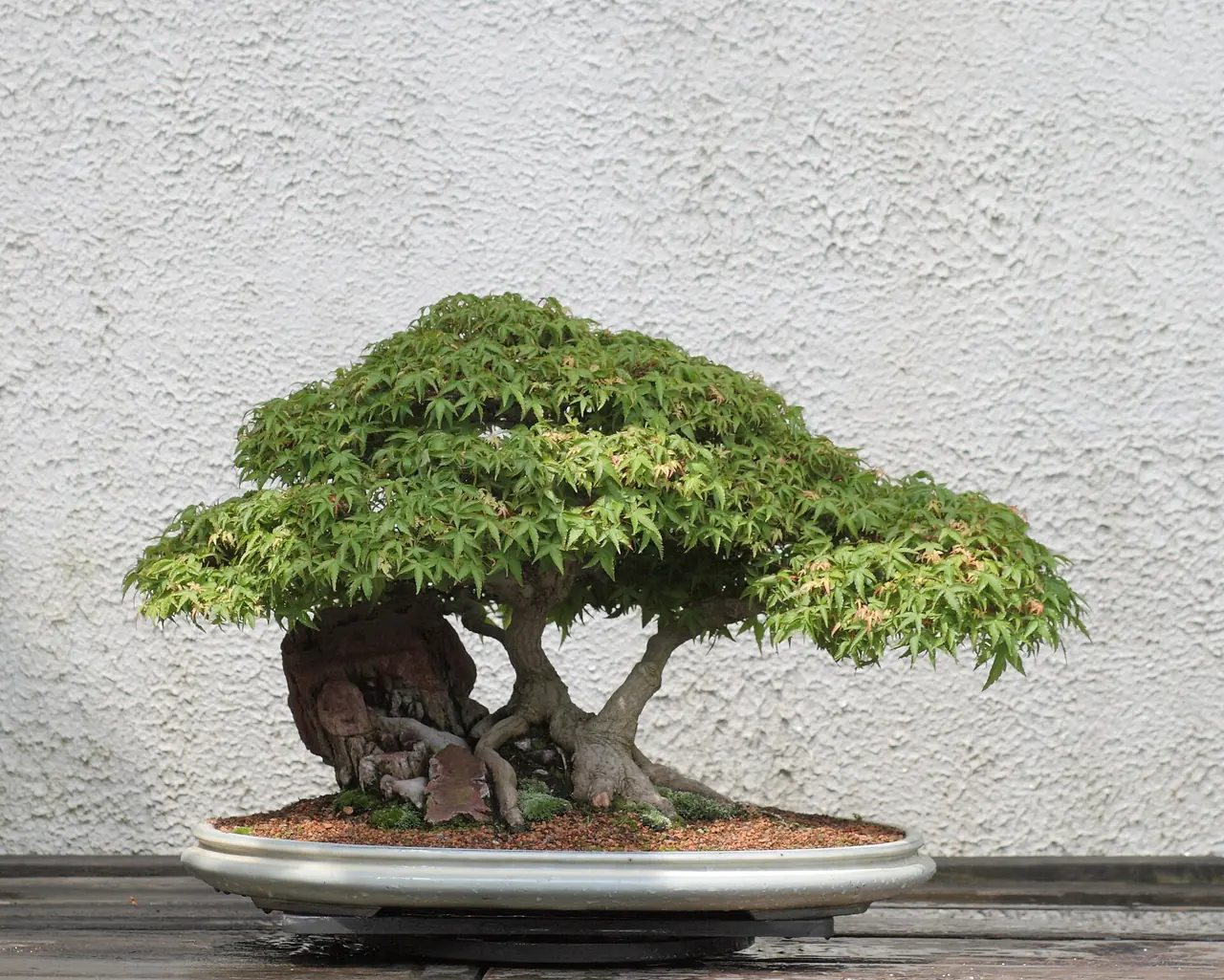
Water when the soil is starting to dry, not by the calendar, and check at least once a day. When you water, keep going until water runs from the drainage holes. The soil should be a fast-draining, mostly mineral mix that lets water run straight through; ordinary potting soil in a bonsai pot is a warning sign.
How to tell when a tree needs water
- Look. Akadama and most mineral soils turn lighter as they dry, Bonsai Empire notes, so you can see it; Bjorholm's nursery waters as the surface becomes visibly dry.
- Feel. Push a finger in about 1 cm (Bonsai Empire) or half an inch (Brent Walston); Harry Harrington waters once the top centimetre has begun to dry.
- Probe or lift. Walston waters when a chopstick comes out nearly dry, or judges by the pot's weight.
- Look below the surface. Jonas Dupuich found one black pine still wet half an inch down under a dry surface, and waited a day. The opposite also happens: a dark, wet-looking surface over a rootball that is dry a quarter of an inch down.
- Do not trust rain. Light rain often wets only the top, Harrington warns, and Dupuich says a tree may need water even while it rains.
If a tree wilts, feel the soil before watering: if it is wet, the roots are in trouble, and Walston's answer is to let it dry, not to water.
How to water
- Pour from above through a fine rose, so the soil is not washed out.
- Keep going until water runs from the drainage holes.
- Water again; Harrington leaves 10 to 20 minutes before the second pass.
- If the core stays dry after three or four waterings, soak the whole pot in a basin, as Dupuich does.
- Then let it come back to almost dry before the next watering.
How often
No source gives a timetable: sun, wind, heat, humidity and pot size all change it. Walston calls one day the ideal interval for outdoor trees in the growing season. Bjorholm's nursery checks at least twice a day in spring and summer, and in autumn and winter waters anywhere from daily to once every 2 to 5 days. In Saitama, Hiromi Hamano waters once a day in spring and autumn, twice in summer and two or three times a week in winter.
Pot size matters: in the same summer weather, Dupuich's pines in colanders need water every one to two days, his field-grown pines in large containers every four to five. A coarser, airier mix needs water more often.
Too wet or too dry?
Dupuich warns that the two look alike; the clue is whether the soil was usually wet or dry when you watered.
| Too wet | Too dry | |
|---|---|---|
| Speed | Slow: weeks to months | Fast on broadleaves, "within hours or days"; conifers much more slowly |
| Leaves | Gradual yellowing; old and new leaves fall together; wilting while the soil is moist | Wilting, rapid yellowing then drying, brown tips, sudden leaf drop |
| Conifers | Pine needles yellow at the base; a juniper's shoots run long or turn juvenile (Dupuich) | Foliage turns bronze or copper; juniper tips die back |
| Roots | Dark, squishy and smelly; healthy roots are "blonde to reddish brown" (Michael Hagedorn) | Once fully dry, Bonsai Empire says, the tree cannot be saved |
Eric Schrader names overwatering the biggest killer; Harrington has seen many trees lost to a single missed watering. Hagedorn links them: a tree dries, roots die, it is overwatered, and it rots.
By species
- Black pine. Mirai lets the soil dry out thoroughly between waterings; Dupuich lets pines partly dry, and Harrington says no pine should dry out completely.
- Japanese maple. Thirstier than other deciduous trees: the soil should never dry out completely, and it is very thirsty before each flush of growth. Bonsai Empire advises against hard water for maples.
- Juniper. The mall juniper does not tolerate wet soil, NC State notes, and Bonsai Empire calls overwatering one of the commonest causes of juniper decline.
The soil
Walston aims for about 25% water and 25% air by volume after draining, in a mix that drains fast enough to watch the water go through. The usual parts:
- Akadama, a Japanese clay that holds water and starts to break down after about two years (Bonsai Empire), sooner without pumice or lava (Harrington).
- Pumice, a soft volcanic rock that holds water and nutrients; Hagedorn prefers it to lava partly because it is lighter.
- Lava rock, which helps hold water and gives the mix structure, but is heavy and wears out tools.
Ratios are akadama to pumice to lava unless stated.
| Tree | Mixes growers use |
|---|---|
| Black pine | Mirai 1:1:1; Bonsai Empire equal thirds for conifers; Hagedorn 1 akadama to 2 pumice; Dupuich about 25 to 30% akadama for trees in development; Harrington lava and pumice |
| Japanese maple | Bjorholm 2 akadama, 1 lava, 1 pumice; Bonsai Empire 50:25:25; Hagedorn half akadama, half pumice; Dupuich up to 50% akadama for trees in development |
| Juniper | Bjorholm Aoki Blend or 1:1:1, about 3/16 inch (4 mm) for medium and large trees; Mirai 1:1:1; Harrington inorganic, avoiding pure akadama |
Refined trees get more akadama, to slow growth: Dupuich gives 30 to 60% for conifers and 50 to 80% for deciduous trees. If you cannot water often, Bonsai Empire adds akadama and Dupuich uses smaller particles; in a wet climate, more lava or grit and larger particles. After a cool summer Dupuich chose a drier mix, preferring to water more often than to wait for wet soil to dry.
Particle size. Harrington uses 4 to 5 mm for most trees, 2 to 3 mm on the surface and some 6 to 7 mm particles for pines; Hagedorn sifts out the 1/16 inch size for conifers but leaves it in for deciduous trees. Smaller particles hold more water and less air, and growth slows. Sift out the dust, which blocks drainage, and flush the pot after repotting until the water runs clear. The same mix stays wetter in a shallower pot, because a saturated layer sits at the bottom whatever the pot's depth.
pH. Dupuich writes that bonsai prefer slightly acidic water, below pH 7, and that tap water is often alkaline. Extension figures give black pine a wide tolerance, Japanese maple acid to slightly alkaline, and junipers neutral, 6.0 to 8.0. Youngest leaves yellowing between green veins point to iron chlorosis, most often from soil or water that is too alkaline.
Potting soil is a red flag. Mall trees often arrive in ordinary potting soil, and a UK nursery repots such imports at the next opportunity. Peat keeps breaking down and compacting in the pot, Harrington explains. Bonsai Empire keeps garden soil for young trees in large training pots.
After repotting
Water a just-repotted pine less often: the new soil stays wet until roots grow into it. Dupuich's black pines repotted that year needed water every other day, those repotted a year earlier every day. Then a week out of sun and wind, with slightly less water (Phoenix Bonsai Society).
Dormant trees and frozen pots
Dormant trees use little water: check them and water when dry. Bjorholm waters pines and junipers as little as once every 3 to 5 days and maples every 5 to 7, probably written at his Tennessee nursery, with hot, humid summers. Trees stored somewhere cool, Dupuich finds, may need watering once a month.
Do not let the pot dry out before a freeze: Hagedorn, in Portland, calls dry soil one of the worst dangers, since water insulates the roots and freezing dries the soil. Water thoroughly before cold, drying winds, Walston adds. If the soil freezes, we recommend keeping it thawed: do not let the roots stay frozen for long, and protect and water as needed. Water in the warm part of the morning, so no extra water freezes at night.
Where growers differ
Watering a repotted pine. Where growers differ, we recommend watering less often (above). Dupuich waters his freshly repotted pines about half as often; Hagedorn warns that the old root core can dry out while the new soil is still moist.
A frozen rootball. Where growers differ, we recommend keeping it thawed, with Hagedorn, who relays his teacher Mr Suzuki thawing trees a little each winter day to water them. Chicago Botanic Garden says "never water a tree with a frozen root system", and Mistral Bonsai waits for the soil to thaw. A Japanese guide finds a pot that thaws by day fine, but warns that roots frozen all day cannot drink.
Moist or dry before a freeze. Growers differ, with no recommended way: Hagedorn and Rutgers want moist soil, while Kaizen Bonsai (UK) keeps trees drier, its figures being for olive.
Hard water. Growers differ, with no recommended way. Bonsai Empire prefers rainwater but finds tap water fine; Harrington uses tap water, flushes with rain in hard-water areas, and never softened water; Dupuich acidifies. In a 52-week nursery trial, harder water left the substrate less acidic. Walter Pall uses some of Europe's hardest water, 23° DH, for everything, azaleas included.
Moss. Growers differ, with no recommended way. A Japanese forum answer says light watering runs off moss without soaking in, and Dupuich (2012) found green moss hiding dry soil. A Japanese bonsai artist reads moss colour to judge watering, and Dupuich (2020) takes healthy moss as a sign the surface is just moist enough.
The chopstick. Our recommendation, where growers differ, follows Bjorholm: in a mineral mix such as akadama, lava and pumice, a probe is not needed; water as the surface becomes visibly dry. Walston waters when a chopstick comes out nearly dry, and Dupuich describes cases where the surface misleads; if your surface has misled you, as it did Dupuich, probe as Walston does.
Organic matter. Growers differ, with no recommended way. Harrington and Bonsai Empire avoid it or allow only bark; Pall adds 15 to 20% coarse peat, bark or coconut fibre; Hagedorn uses organics only for young plants.
Common mistakes
- Watering on a schedule: check the soil every day.
- A quick sprinkle: water until it drains, then again.
- Watering a wilted tree in wet soil: feel first, and let it dry.
- Potting soil in a bonsai pot: change to a mineral mix at the next repotting, in season.
Related
Sources
- Bonsai Empire: Watering, Bonsai soil, Troubleshooting, Juniper, Japanese maple
- Harry Harrington, bonsai4me: Watering, Soils, Pine guide, Juniper guide, Japanese maples
- Bjorn Bjorholm, Eisei-en: Watering, Japanese maple, Juniper, Pine
- Bonsai Mirai: Japanese black pine, Repotting conifers, Japanese maple
- Brent Walston, Evergreen Gardenworks: Watering, Soils, Earth and pot
- Jonas Dupuich, Bonsai Tonight: Watering conifers, Watering deciduous bonsai, part 2, Summer watering tip, Summer watering, How to tell something is wrong, Spring watering tips, Lowering water pH, Repotting strategy, What soil should I use?, All about akadama, Winter care
- Michael Hagedorn, Crataegus Bonsai: Freezing weather and watering, It's repotting time, Lava woes, On root rot
- Walter Pall: Bonsai soil, on AusBonsai
- Wayne Schoech, Bonsai Bark: The art and science of watering
- Eric Schrader, Gardenista: Bonsai basics; Hiromi Hamano, aff, 2017: bonsai feature
- Phoenix Bonsai Society: Repotting
- Winter: Chicago Botanic Garden, Mistral Bonsai, Shinto-kimiko, Rutgers, Kaizen Bonsai, Michael Hagedorn via Bonsai Bark
- Moss: Yahoo! Chiebukuro, moss browning, Creema, with Sekibokka
- Mall trees: Adam Lavigne, mallsai, Greenwood Bonsai Studio
- Plant science: NC State, Juniperus procumbens, Pinus thunbergii, Juniperus chinensis; UF/IFAS, Acer palmatum; Robbins and Evans, Arkansas; Albano et al. 2017; University of Maryland Extension