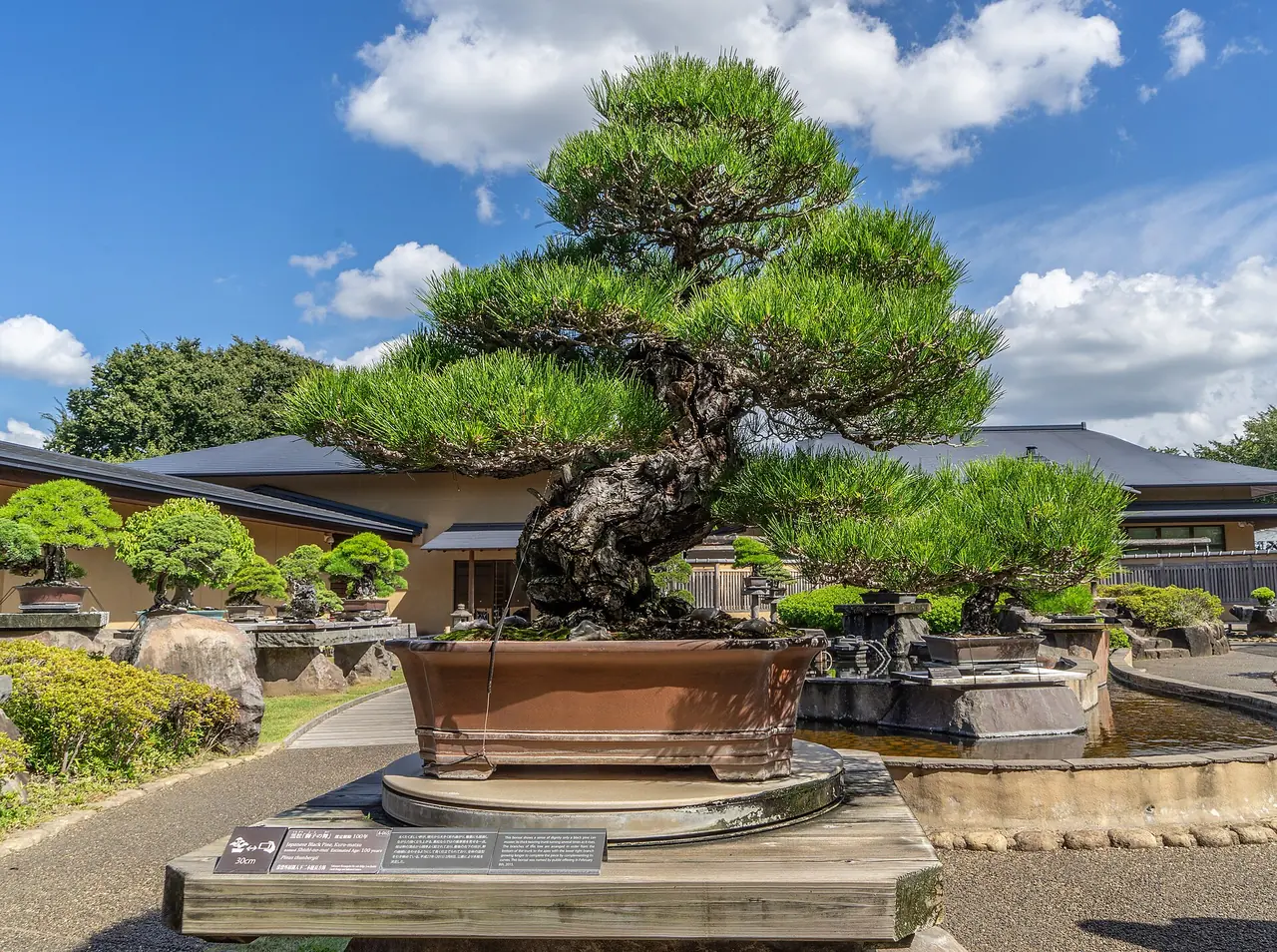
The greatest single show is the Kokufu-ten (国風盆栽展), held in Tokyo every winter, where trees are admitted only after a strict pre-judging. For a visit any time of year, the leading public collections include the Omiya Bonsai Art Museum and the nurseries of Ōmiya Bonsai Village in Saitama, the National Bonsai & Penjing Museum in Washington, and the National Bonsai and Penjing Collection of Australia at the National Arboretum Canberra. Opening hours, fees and closures change, so check each place's official page before you go.
The Kokufu-ten
What it is. Bonsai Empire calls the Kokufu-ten "Japan's leading Bonsai show", and Wikipedia "the most prestigious bonsai competition for amateur-owned trees". It began in 1934, and the 100th edition opened in 2026; that edition, Valavanis notes, "commemorates the 100th anniversary, not 100 years". One compiled history, Robert Baran's, explains why: the 19th show was numbered but never held, because of the war. The Nippon Bonsai Association runs it; sources differ on when it took over, 1964 according to Valavanis, 1965 in Baran's history.
When and where. The show is held at the Tokyo Metropolitan Art Museum in Ueno Park, in late winter. It now runs in two parts of about four days each, with a day or two between them in which every tree is replaced. In 2025 an adult ticket cost 1,000 yen, or 1,500 yen for both parts.
How trees are chosen. No one can enter a tree alone: it must come through a professional handler, Baran's history says, and Kathy Shaner reported in 1991 that the handler must belong to the professionals' cooperative. Entries are judged at the Ueno Green Club some weeks before the show; accounts differ, from about two weeks (Baran, Shaner) to three weeks or a month (Cheryl Manning). Baran's history records thirteen judges; a 1978 account has twelve. At the 68th show the 248 displays were "only forty percent of the trees submitted", Manning wrote. Trees registered by the Association as important masterpieces (kicho) are accepted automatically.
The prize. After the show is set up, a small group of Association officers picks the Kokufu prize winners, and "A bonsai can only win once". The award honours the tree: as Baran's history puts it, "the bonsai is the main object of the award, NOT the artist".
Visiting. Nothing may be sold in the museum, so trees, pots and tools are sold at the Ueno Green Club, about ten minutes away, with a free shuttle bus. On the opening day in 2026 Valavanis counted 2,500 visitors, "over 70% foreigners".
Public collections: Japan
Omiya Bonsai Art Museum (さいたま市大宮盆栽美術館), Saitama, opened in 2010 and is run by Saitama City; Japanese Wikipedia calls it the world's first public bonsai museum. Its core is about 100 masterpieces the city bought from the former Takagi Bonsai Museum, and the indoor gallery changes weekly. It closes on Thursdays unless a holiday falls then; an adult ticket was 310 yen.
Ōmiya Bonsai Village (大宮盆栽村), next door, began about 1925 when growers moved out from Tokyo. It had about 35 gardens at its peak. Sources differ on today's six: the village site lists Kyūka-en, Seikō-en, Toju-en, Fuyō-en, Mansei-en and Shōsetsu-en, while Japanese Wikipedia and the national tourism body name Shoto-en in place of Shōsetsu-en. A French travel guide says the gardens are free to visit but photographs are forbidden. The Great Bonsai Festival has been held each spring since 1984.
Shunkaen BONSAI Museum (春花園BONSAI美術館), Edogawa, Tokyo, was opened by Kunio Kobayashi in 2002 and holds about 1,000 bonsai. It opens from 10:00 to 17:00, is closed on Mondays except public holidays, and charges 2,000 yen, paid in cash.
The Imperial collection. Roughly 500 trees are kept in the Omichi Garden of the Imperial Palace, and around 300 are used each year at official occasions. Our research found no regular public display.
Masters' gardens. Daiju-en in Okazaki asks visitors to make contact before coming, and at Shinji Suzuki's Taikan museum in Obuse most trees are in cold houses in winter. Their makers are in the great bonsai masters.
Public collections: Australia
The National Bonsai and Penjing Collection of Australia (NBPCA) is "a partnership between the ACT Government and the Australian Bonsai Community". It opened in 2008 in Commonwealth Park and moved to the National Arboretum Canberra in 2013. It holds 120 exhibits, with about 75 trees on show at any one time, and highlights Australian natives such as Banksia serrata and Eucalyptus camaldulensis. Australia's strict quarantine rules mean all of its trees were grown and shaped by Australian artists; the oldest dates to 1880 and spent about 100 years in a hedge. Trees come in on loan or as gifts, and the selection committee usually does not know whose tree it is, so "it is purely the tree that is being assessed". The collection counted about 175,000 visitors a year in 2020 and opens daily from 9 am to 4 pm, closed on Christmas Day; its page states no admission fee. In 2023 it signed a sister-museum agreement with the Omiya Bonsai Art Museum.
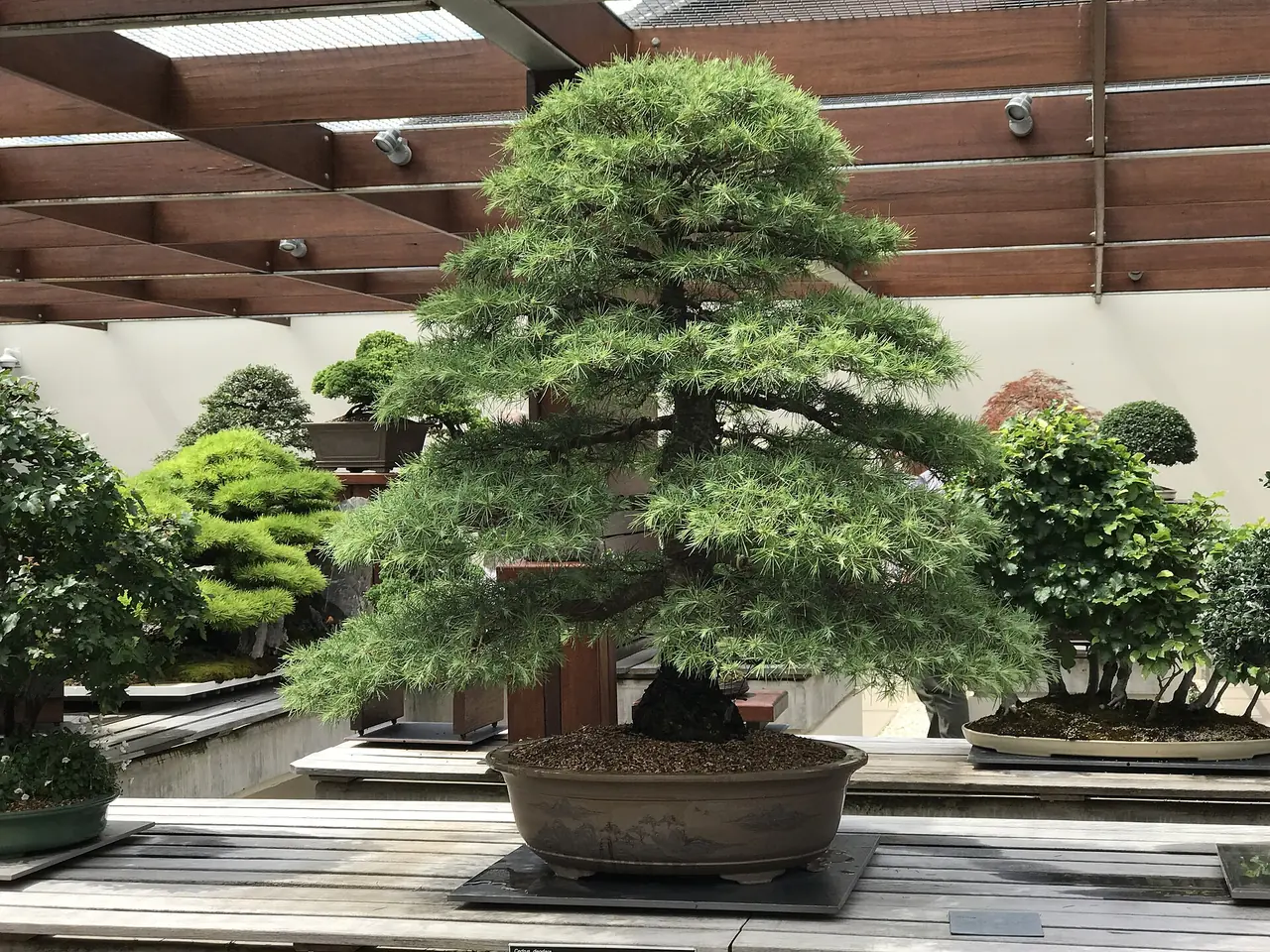
Elsewhere, the Bonsai House at Brisbane Botanic Gardens Mt Coot-tha opened in 1999, mainly with trees donated by the late Len Webber, and a visitor article counts around 80 trees, free daily from 9 am to 4 pm.
Public collections: North America
- National Bonsai & Penjing Museum, U.S. National Arboretum, Washington: three pavilions (Chinese, Japanese and the John Y. Naka North American), a tropical conservatory and the Yuji Yoshimura Center; open daily from 10 am to 4 pm, free, with no tickets needed. In winter the Japanese and North American pavilions close and selections move to the Chinese Pavilion.
- Pacific Bonsai Museum, Federal Way, Washington: opened by Weyerhaeuser in 1989 and given to a non-profit at the end of 2013; over 150 trees from Japan, China, Taiwan, Korea, Canada and the United States; admission by recommended donation, closed on Mondays.
- Brooklyn Botanic Garden, C.V. Starr Bonsai Museum, New York: begun in 1925, now about 400 bonsai, with up to 30 on show at a time.
- The North Carolina Arboretum, Asheville: since 2005, up to 50 of its more than 100 trees on show, from late spring to late autumn.
- Morikami Museum and Japanese Gardens, Delray Beach, Florida: a World Bonsai Friendship Federation Cooperation Center since 2013; closed on Mondays, with tickets sold only at the door.
- Also worth the trip: Longwood Gardens, Pennsylvania, founded in 1959 on 13 trees from Yuji Yoshimura; the Chicago Botanic Garden, with nearly 300 trees; and the Montreal Botanical Garden, about 350 bonsai and penjing with some 120 on show, including Wu Yee-sun's gifts.
Public collections: Europe
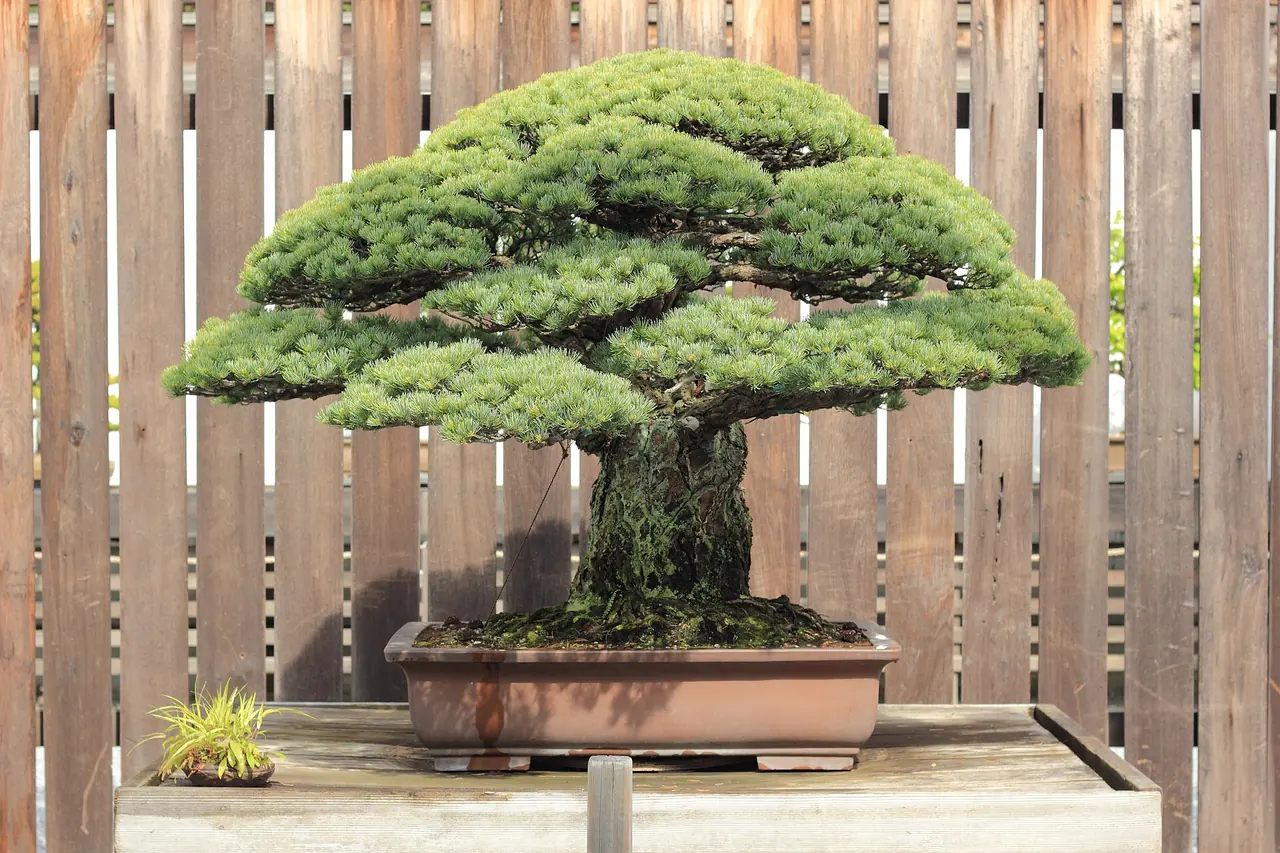
- Crespi Bonsai Museum, Parabiago, near Milan: opened in 1991; the museum calls itself "the world's first permanent bonsai museum" and shows about 200 works in rotation with the seasons. Sources differ on firsts: Omiya claims the first public museum, and the City of Heidelberg calls the Heidelberg centre's museum the only one in Europe.
- Luis Vallejo Bonsai Museum, Alcobendas, Madrid: open since 1995, more than 200 trees of native Spanish species beside Japanese ones; closed on Mondays and through the height of summer.
- Japan Bonsai Museum, Seeboden, Austria: since 1976, about 3,000 bonsai; the museum and Günther Klösch, who runs it, received the Order of the Rising Sun in 2017.
- Others: Kew Gardens, London, with nearly 60 bonsai, a club report says; and the Vallée-aux-Loups Arboretum near Paris, a free park with 66 bonsai from Rémy Samson's collection.
Public collections: Asia and elsewhere
- China: Wanjing Shanzhuang at Tiger Hill, Suzhou, opened in 1982 and shows over 600 penjing, each rested for about three years after five to eight years on show. The Shanghai Botanical Garden's penjing garden covers 4 hectares with more than 2,000 pieces, and Liuhua West Garden in Guangzhou holds around 560 Lingnan bonsai.
- Hong Kong: the Man Lung Garden at Hong Kong Baptist University, founded in 2000 with Wu Yee-sun's support; its visiting hours were not found.
- South Korea: the Spirited Garden on Jeju, with 2,000 bonsai of about 100 species in a 2008 account, open all year.
- India: the National Bonsai Park in Lodhi Garden, New Delhi, which hosts exhibitions.
Major shows and conventions
- Japan, beyond the Kokufu-ten: the Sakufu-ten, the professionals' show, credits the artist and gives one grand prize; by one compiled history, the Taikan-ten in Kyoto, first held in 1981, shows trees in formal alcove displays with scrolls, and the Gafu-ten in Kyoto, first held in 1976, is the leading show for small (shohin) bonsai.
- World Bonsai Convention: held every four years in a different country since the first at Ōmiya in 1989; the 2017 convention in Saitama drew "OVER 40,000 people".
- ASPAC (Asia-Pacific Bonsai and Suiseki Convention): every two years since the first in Bali in 1991; the 17th, in Gianyar, Bali, in 2025, drew delegations from 16 countries.
- United States: the U.S. National Bonsai Exhibition in Rochester, New York, every two years since 2008, judged by three judges from outside the country; and the Pacific Bonsai Expo in California, where the exhibitors themselves judge.
- Europe: The Trophy (formerly the Noelanders Trophy) in Genk, Belgium, in late winter, which a UK club report calls "the premier bonsai show in Europe"; and the European Bonsai Association's convention, which moves between countries each year.
- Australia: the AABC National Bonsai Convention, hosted by a different member club each year, usually in late autumn; the 2025 convention in Canberra showed over 130 bonsai displays and awarded trophies.
- Taiwan: the Hwa Fong exhibition, the island's most important annual show; sources differ on its 2017 gold awards (ten or eleven) and on its organiser's name.
Before you go
- Check the official page first; several collections close one weekday (Omiya on Thursdays; Shunkaen, Pacific Bonsai Museum and Morikami on Mondays).
- Expect different trees on each visit: Brooklyn shows up to 30 of its 400, Omiya changes its gallery weekly, and Crespi rotates by season.
- At the Kokufu-ten every tree changes between the two parts, so a two-part ticket shows you twice as many.
The places and people named here are listed as history and as places to visit; none is a partner or endorser of this site.
Sources
- Kokufu-ten: Valavanis, 100th Kokufu-ten, part 1, Valavanis, 100th Kokufu-ten statistics, Valavanis, 2017, Valavanis, 2015, Valavanis, Ueno Green Club, Bonsai Empire, Wikipedia, Bonsai, Tokyo Metropolitan Art Museum calendar, 2025, Bonsai Tonight, 2026, Cheryl Manning, A Taste of Toyohashi, Cheryl Manning, The Kokufu Gamble
- Robert J. Baran, Magical Miniature Landscapes (a hobbyist compilation): Kokufu history, list of shows, observations, Taikan-ten, Gafu-ten, Conventions Part II, Conventions Part III
- Japan: Saitama City, Omiya Bonsai Art Museum, Wikipedia (ja), Omiya Bonsai Art Museum, Wikipedia (ja), Omiya Bonsai Village, Ōmiya Bonsai, gardens, JNTO, Omiya Bonsai Village, Kanpai, Shunkaen museum, Wikipedia (ja), Shunkaen, News On Japan, Imperial bonsai, Daiju-en, history, Bonsai Empire, Taikan museum, Valavanis, Sakufu-ten judging, Bonsai Tonight, Sakufu-ten
- Australia: National Arboretum Canberra, NBPCA, National Bonsai Foundation, Canberra, AusBonsai forum, NBPCA 2013, National Arboretum, sister museum, WeekendNotes, Bonsai House, AABC events, Canberra Bonsai Society, 2025 convention
- North America: National Bonsai Foundation, the Museum, NBF, plan your visit, NBF, Yamaki pine, Valavanis, Pacific Bonsai Museum, Atlas Obscura, Pacific Bonsai Museum, Brooklyn Botanic Garden, 100 years of bonsai, BBG, bonsai museum, NC Arboretum, bonsai garden, Morikami, bonsai, Morikami, hours, Longwood, bonsai, Chicago Botanic Garden, bonsai, NBF, Montreal, US National Bonsai Exhibition, Pacific Bonsai Expo, entries
- Europe: Crespi Bonsai Museum, Luis Vallejo Bonsai Museum, El Mundo via the museum, Japan Bonsai Museum Seeboden, City of Heidelberg, Swindon club, Kew, Sortiraparis, Vallée-aux-Loups, The Trophy, Swindon club, Noelanders Trophy 2017
- Asia: China Daily, Wanjing Shanzhuang, Tuniu, Shanghai Botanical Garden, Swindon club, Liuhua West Garden, HKBU, Man Lung Garden, Business Traveller, Spirited Garden, Korea Trip Tips, Spirited Garden, The Pioneer, Lodhi Garden, Bonsai Empire, Hwa Fong, Valavanis, Hwa Fong 2017, detikBali, ASPAC 2025
- Conventions: Valavanis, World Bonsai Convention 2017, 2007 ASPAC news item