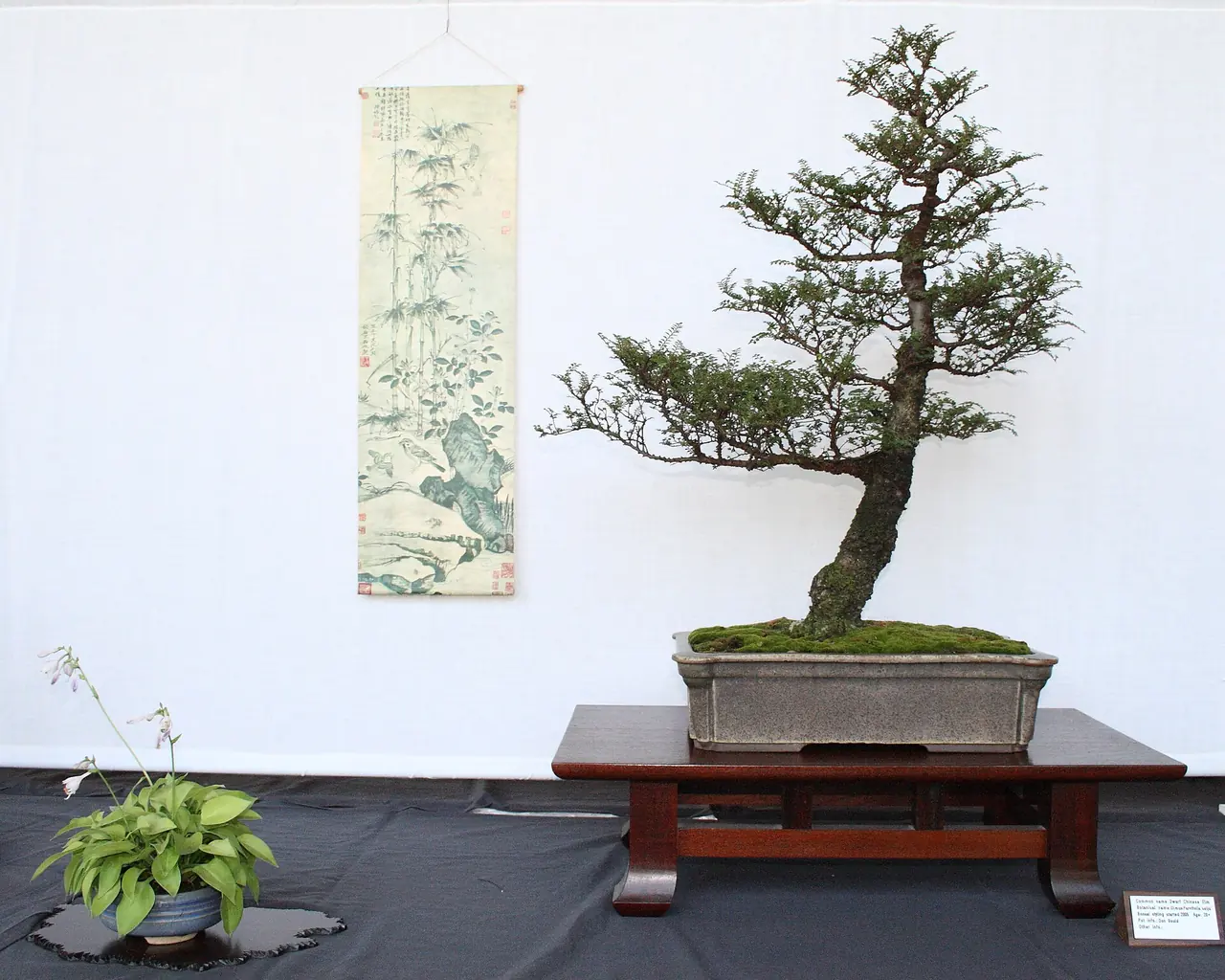
Bonsai has its own vocabulary, most of it Japanese. This page gives each word in English, its Japanese name as our sources print it, and a short definition in plain words. Where another tradition, such as Chinese penjing, uses a different word or a different idea, the entry says so.
How to read this glossary
- Japanese names are given in kanji or kana as our sources print them, followed by the romaji. Where a source prints the characters but no reading, we say the reading was not found rather than guess one.
- Not found means none of our sources gives a Japanese word for the term; many English working terms have none.
- Not yet in our research means we have not yet looked for a Japanese word for the term.
- Other languages are coming. Chinese, Cantonese, Vietnamese, Korean and Indonesian names are collected in our research, and each will be added once a native-speaking grower has checked it.
- Sources differ marks a word whose spelling, reading or meaning varies between sources.
A
Accent plant
Japanese: 添え soe (the companion in a formal display)
A small plant, such as a grass or a flowering plant, set beside a bonsai, usually when the tree is shown formally. In a Japanese alcove display the companion can also be a stone or a small figurine; the low planting itself is called shitakusa.
Air layering
Japanese: 取り木 (とりき) toriki
Making a branch grow roots at a chosen point while it is still on the tree, then cutting it off below the new roots as a tree of its own.
Akadama
Japanese: 赤玉土 (あかだまつち) akadamatsuchi, "red ball earth"; short form 赤玉
A Japanese clay sold as small, hard granules and used as a main ingredient of bonsai soil. It holds water well and slowly breaks down in the pot, which is why it is mixed with pumice or lava; see Watering and soil.
Apex
Japanese: 樹芯 (reading not found in our sources)
The top of the tree. It can be a single branch, a cluster of small branches, a mass of foliage or a piece of deadwood.
Approach grafting
Japanese: 呼び接ぎ (reading not found in our sources)
Grafting a branch onto a tree while that branch is still attached to, and fed by, the plant it grows on.
B
Back branch
Japanese: not found
A branch growing toward the back of the tree. The classic rules make the third branch a back branch, placed off to one side rather than straight behind the trunk.
Bar branch
Japanese: 閂枝 (reading not found in our sources)
Two branches leaving the trunk at the same height on opposite sides, like a bar through it. Japanese lists count it among the faulty branches.
Bonkei
Japanese: 盆景 (ぼんけい) bonkei; older names 盆石 (ぼんせき), 盆庭 (ぼんてい), 盆山 (ぼんさん)
A Japanese tray landscape modelled from soil, sand, stones, moss and plants. Sources differ on whether it holds living trees: English Wikipedia says it does not, while Bonsai Empire includes small trees.
Traditions differ: the same characters, read in Chinese, name penjing, a different and much larger art.
Bonsai
Japanese: 盆栽 (ぼんさい) bonsai
A tree grown in a container and shaped so that it looks like a mature tree in small; the word also names the art itself. Our guide to starting covers a first tree.
Traditions differ: in Chinese the art is usually called penjing, and one Hong Kong penjing society uses the word written with the same characters as bonsai for any plant grown in a pot. Korean has a separate, narrower word for landscape plantings, and Vietnamese uses a common everyday word for ornamental potted plants beside a distinct art of artificial mountains set in water.
Bonsai scissors
Japanese: 盆栽鋏; 鋏 is read はさみ (hasami). Also 剪定鋏 (pruning shears), 小枝切り鋏 (twig shears) and 葉切り鋏 (leaf shears)
Scissors made for bonsai work, sold in many sizes and shapes for pruning, twigs and leaves. See tools to start with.
Broom
Japanese: 箒立ち (ほうきだち) hokidachi
A style with a straight trunk that divides at about a third of its height into many branches, making a domed crown like an upturned broom. See Bonsai styles and sizes.
Bud swell
Japanese: described rather than named, as 芽が膨らみ始めた ("the buds have begun to swell") or 芽が動く前 ("before the buds move").
The stage when buds fatten and their scales start to loosen: late winter in a mild climate, early spring where winters are cold. It is the main window for repotting; see When to repot.
C
Candle
Japanese: ミドリ (みどり) midori, the extending pine shoot; pinching it is ミドリ摘み; also ろうそく芽, "candle bud" (reading not found in our sources).
A pine's new spring shoot, which lengthens like a candle before its needles open. On a strong black pine it is the part removed in decandling.
Cascade
Japanese: 懸崖 (けんがい) kengai
A style whose trunk falls over the edge of the pot so that its tip hangs low beside it. Sources differ on how low: most English sources put the tip below the base of the pot, Japanese Wikipedia only below the rim. See Bonsai styles and sizes.
Chinese elm
Japanese: アキニレ (秋楡) akinire
The elm Ulmus parvifolia. It is semi-evergreen: outdoors in a cold autumn it drops some or all of its leaves, while in a mild winter it stays green; see our gift bonsai guide.
Chuhin
Japanese: kanji not found; also chumono, chu
A medium size class. Sources differ on its limits: about 41 to 91 cm for chumono in the Wikipedia scheme, 40 to 60 cm for chu at the Taikan-ten show, and 35 to 45 cm for chuhin at Gafu-ten in 2020.
Clinging to rock
Japanese: 石付 (いしつき) ishitsuki (Japanese Wikipedia); 石附き (Bonsai Empire's Japanese edition)
A style in which the roots live in soil held in the rock itself and do not reach soil in a pot; the rock is often set in a shallow tray of water or gravel. Sources differ on the spelling: ishitsuki, ishizuki, ishizuke and ishisuki all appear in English.
Clip and grow
Japanese: not found
The training method of the Lingnan school of Chinese penjing: the trunk is shortened, then each new section of branch is grown out and cut back, joint by joint, so that the tree is shaped by pruning alone, with no wire or weights.
Traditions differ: this is a different method from Japanese wiring, not only a different word for it.
Clump
Japanese: 株立ち kabudachi
Several trunks rising together from one point at the base. Sources differ on the count: three or more in Bonsai Empire's Japanese edition, five or more in Japanese Wikipedia.
Coiled trunk
Japanese: 蟠幹 (ばんかん) bankan
A style whose trunk twists back on itself strongly, like a snake lying in coils.
Collected tree
Japanese: 山採り yamadori
A tree dug from the wild, already shaped by nature before any grower worked on it.
Traditions differ: Chinese penjing traditionally started from collected stumps, which Robert Baran gives under a Chinese name meaning tree stump.
Concave cutter
Japanese: 又枝切り (reading not found in our sources)
A cutter for taking a branch off flush with the trunk, leaving a flat or slightly hollow cut. See tools to start with.
Cut paste
Japanese: 癒合剤
A wound sealant spread over a pruning cut to help it heal and to stop sap bleeding from it.
Cuttings
Japanese: 挿し木 (Bonsai Empire's Japanese edition; its web address spells it sashiki)
New plants raised from shoots cut from a tree and made to root.
D
Decandling
Japanese: 芽切り mekiri; the second-flush shoots are 二番目 nibanme, and a later partial cut is 中芽切り chu-mekiri
Cutting off a black pine's spring candles once the first flush has matured, so that the tree grows a second, shorter flush with shorter needles. See Decandling black pine.
Defoliation
Japanese: 葉刈り and 葉切り, found in our sources only in tool names such as 葉切り鋏 (leaf-cutting shears)
Also called leaf cutting: removing all or most of a tree's leaves in the growing season, so that it grows a new set, smaller and with shorter spaces between them. Our maple guide explains why we take only some leaves from a Japanese maple.
Sources differ: on black pine, 葉切り means something else, cutting the needles shorter.
Display
Japanese: 飾り kazari; 床飾り toko-kazari in the alcove, 席飾り seki-kazari at home or at a show
Showing a bonsai formally, where the setting, the part each object plays, the line of the tree and the empty space around it all follow set conventions.
E
Eye-poker
Japanese: not found
A branch pointing straight at the viewer from the front of the tree. The classic rules ask for none, and the same goes for roots.
F
Faulty branches
Japanese: 忌み枝 (いみえだ) imieda
The Japanese collective term for branches that spoil a tree's form and are normally removed. The list includes branches radiating from one point, bar branches, parallel, upright, inward-growing and crossing branches.
Ficus
Japanese: ガジュマル gajumaru
The Chinese banyan, Ficus microcarpa, often sold as an indoor bonsai; see our gift bonsai guide.
Figurine
Japanese: 添配 tenpai (reading from English-language sources)
A small figure, such as a little house, an animal or a person, used as the companion object in a display.
First branch
Japanese: 一の枝 (reading not found in our sources)
The lowest main branch of the tree; on a slanting tree it usually grows on the side away from the lean. Growers differ on how high it should start; see Bonsai styles and sizes.
Flush
Japanese: 一番芽 for the spring shoots that candle cutting removes, and 二番芽 for the regrowth (readings not found in our sources); no general word for "a flush of growth" was found.
A burst of new shoots and leaves. A mature Japanese maple makes one flush a year unless leaf removal or cutting forces another, while a strong black pine can be made to grow a second flush.
Forest
Japanese: 寄せ植え (よせうえ) yose-ue
A group planting: many separate trees, usually of one species and of varied heights, in one container.
Formal upright
Japanese: 直幹 (ちょっかん) chokkan
A straight, vertical trunk with its apex directly above the base. See Bonsai styles and sizes.
Traditions differ: Chinese penjing does not use the Japanese style list; Robert Baran gives six basic Chinese forms, among them a straight trunk, a slanting trunk, a cliff-hanging form and a forest.
Front
Japanese: 正面 (reading not found in our sources)
The side a tree is designed to be seen from. The classic rules ask for the apex to lean toward the viewer, with more branches at the sides and back than at the front.
G
Grafting
Japanese: 接ぎ木 (つぎき) tsugiki; the scion is 穂木 (ほぎ) and the rootstock 台木
Joining a branch, or roots, from one plant to another so that they grow on as one.
H
Hachi-uye
Japanese: kanji not found
A very large size class, about 102 to 152 cm tall in the scheme Wikipedia and Bonsai Empire give.
Hanging scroll
Japanese: 掛軸 kakejiku; one kind of 掛物 (かけもの) kakemono
A scroll hung at the back of a formal display, where it sets the season.
Hardening
Japanese: described with the verb 固まる, "to set", as in 二番芽が固まる, "the second shoots harden"; a verb, not a term.
The stage when a flush of new growth firms up: shoots stiffen and the new leaves or needles darken. Much of the year's cutting, feeding and wiring waits for it; see Japanese maple and black pine by stage.
Hyuga
Japanese: 日向土 (reading not found in our sources)
Pumice from the deposits of southern Kyushu in Japan; it drains freely, holds little fertiliser, and is sold for the bottom layer of pots.
I
Imperial
Japanese: an English name; none found
The largest size class, about 152 to 203 cm tall in the scheme Wikipedia and Bonsai Empire give.
Informal upright
Japanese: 模様木 (もようぎ) moyogi
A curving trunk whose apex still sits directly above its base. See Bonsai styles and sizes.
Internode
Japanese: 節間 (reading not found in our sources)
The length of shoot between two nodes, the points where leaves grow. Pinching and leaf removal are used partly to keep internodes short.
J
Japanese black pine
Japanese: クロマツ (黒松) kuromatsu
The pine Pinus thunbergii, which carries its needles in pairs. A strong tree can be made to grow a second flush in summer, which is why its candles are cut; see our black pine guide.
Japanese maple
Japanese: イロハモミジ (いろは紅葉) iroha-momiji, often simply モミジ momiji
The maple Acer palmatum, which carries its leaves in opposite pairs and makes one main flush of growth a year. See our Japanese maple guide.
Traditions differ: Chinese uses different regional names for it on the mainland and in Taiwan.
Japanese red pine
Japanese: アカマツ (赤松) akamatsu
The pine Pinus densiflora. Like black pine, a strong red pine can have its candles cut; see Decandling black pine.
Japanese white pine
Japanese: ゴヨウマツ (五葉松) goyōmatsu
The pine Pinus parviflora.
Jiita
Japanese: 地板 jiita
A flat display board with no legs, set directly under the pot; it gives a sense of solidity.
Traditions differ: the same characters mean a floor in Chinese, so the word does not carry over.
Jin
Japanese: 神 (ジン) jin
A branch stripped of its bark so that it looks dead and weathered, suggesting great age or a hard life. Deadwood on the trunk is shari.
Jin pliers
Japanese: やっとこ yattoko
Pliers for bending wire and for stripping bark when making jin. See How to wire a bonsai.
K
Kanuma
Japanese: 鹿沼土 (かぬまつち) kanumatsuchi
A soil named after Kanuma in Tochigi, Japan, used especially for azaleas and other acid-loving plants. Sources differ on what it is: Japanese Wikipedia calls it a weathered pumice, Bonsai Empire's glossary a clay.
Katade-mochi
Japanese: kanji not found; older charts write katate-mono
A size class for a tree that can be carried in one hand, about 25 to 46 cm tall in the scheme Wikipedia and Bonsai Empire give.
Keshitsubo
Japanese: kanji not found
The tiniest size class, named after a poppy seed: about 3 to 8 cm tall.
Kifu
Japanese: kanji not found
A size class between small and medium: 20 to 40 cm at the Taikan-ten show, 21 to 35 cm at Gafu-ten in 2020. See size classes.
Kiryu
Japanese: 桐生砂 (reading not found in our sources)
A pumice-like grit, more acidic than ordinary pumice, found in many ready-mixed bonsai soils.
Knob cutter
Japanese: こぶ切り (kana only; romaji not found in our sources)
A cutter for removing stumps and swellings, usually a little at a time; it leaves a deeper hollow than a concave cutter.
Komono
Japanese: kanji not found
A small size class, about 15 to 25 cm tall in the scheme Wikipedia and Bonsai Empire give.
Kumquat
Japanese: キンカン (金柑) kinkan; also キンキツ (金橘)
The small citrus tree Citrus japonica, also placed in the genus Fortunella.
Kusamono
Japanese: 草物 kusamono, literally "grass thing"
A potted planting of small plants shown as the centre of attention in its own right. The same kind of planting set beside a bonsai is called shitakusa.
L
Lava
Japanese: 溶岩石 (Bonsai Empire's Japanese edition)
Crushed volcanic rock used as a bonsai soil ingredient, often with akadama and pumice. See Watering and soil.
Leader
Japanese: 芯 for the growing top, and 樹芯 for the apex (readings not found in our sources); no word was found for a new leader grown after a chop.
The shoot chosen to continue the trunk after a trunk chop, or the branch trained upward to become a pine's new top. It is left to grow freely, often for one to three years, until it is thick enough for the next step.
Lingnan penjing
Japanese: not found
The penjing school of Guangdong and Hong Kong in southern China, also called the Cantonese school. It shapes trees by cutting and regrowing, by the method called clip and grow, rather than with wire. See The great bonsai masters.
Literati
Japanese: 文人木 (ぶんじんぎ) bunjingi; also bunjin, bunjin-gi
A style with a long, slender, mostly bare trunk and a few branches gathered near the top. Bonsai Empire describes the name as Chinese in origin. See Bonsai styles and sizes.
Live vein
Japanese: 水吸い (reading not found in our sources)
On a tree with much deadwood, a strip of living bark that joins the roots to the living branches. Deadwood carving follows it from the base.
M
Main tree
Japanese: 主木 shuboku
The principal tree in a display.
Mame
Japanese: 豆 mame, "bean"; 豆盆栽
A very small size class: about 5 to 15 cm in the Wikipedia and Bonsai Empire scheme, under 7 cm at the Taikan-ten show. See size classes.
Traditions differ: the size classes are Japanese; none of our Chinese, Korean or Vietnamese sources uses them.
Multi-trunk
Japanese: 多幹 (たかん) takan
Several trunks growing from one root base. Japanese names count them: 双幹 for two, 三幹 for three, and 株立ち for five or more (Japanese Wikipedia; Bonsai Empire's Japanese edition says three or more, see clump), with odd numbers preferred.
N
Nebari
Japanese: 根張り nebari (kanji from Japanese sources, romaji from English ones)
The surface roots that spread from the base of the trunk at the soil line, also called the root flare. Our repotting guide shows a good spread in a diagram.
Neagari
Japanese: 根上り (ねあがり) neagari
A style in which the roots stand well above the soil, as though wind and rain had washed the earth away from them. Sources differ on the spelling: some English sources write negari.
Needle plucking
Japanese: 揉み上げ momiage; in Kyoto especially, 葉むしり ha-mushiri
Pulling a pine's old needles by hand, to let light into the tree and balance its strength. See autumn shoot selection in our black pine guide.
Node
Japanese: 節, reading not found in our sources; compare 節間, the stretch between nodes.
The point on a shoot where a leaf or a pair of leaves grows, and where buds form. Japanese maples bud reliably only at nodes, so a cut is made just above one; see the trunk chop.
O
Omono
Japanese: kanji not found; also dai
A large size class: about 76 to 122 cm in the Wikipedia and Bonsai Empire scheme, and over 60 cm for dai at the Taikan-ten show.
P
Pad
Japanese: not found
A mass of foliage carried on one branch, sometimes called a cloud.
Traditions differ: in the Yangzhou school of Chinese penjing, thin, flat foliage layers are trained that Robert Baran calls cloud layers.
Penjing
Japanese: 盆景 (ぼんけい) bonkei, but in Japanese the word names a different art (see bonkei)
The Chinese art of shaping trees, other plants and whole landscapes in miniature in containers, and the parent art of bonsai. Its writers divide it into tree, landscape, and water-and-land penjing.
Traditions differ: Chinese penjing has its own regional schools and style formulas, not the Japanese style list.
Pinching
Japanese: 芽摘み (reading not found in our sources); for pines, みどり摘み midoritsumi
Removing the soft tip of a new shoot with finger and thumb to control and shape the new growth. See Pinching against cutting back.
Pot
Japanese: 鉢
The container a bonsai grows in, usually shallow and of high-fired clay. In Japanese bonsai the match between tree and pot counts for a lot.
Pruning
Japanese: 剪定 (せんてい) sentei; also 整枝 (せいし)
Cutting back shoots, stems and branches to control a tree's shape and how fast it grows.
Pumice
Japanese: 軽石 (かるいし) karuishi; also パミス, 浮石 (ふせき) and 浮岩 (ふがん)
A light volcanic rock full of tiny gas bubbles, mixed into bonsai soil. It holds water and nutrients, and lava is heavier, Hagedorn notes; see Watering and soil.
R
Raft
Japanese: 筏吹き (いかだぶき) ikadabuki
A trunk laid on its side and buried, so that its branches grow up in a line as if they were separate trees. When the buried trunk bends, or several trees have fused at the roots, it is a sinuous raft.
Ramification
Japanese: 枝分かれ, "branching" (reading not found in our sources)
Branches dividing again and again into finer branches, which gives a refined tree its dense twig structure. See our maple guide.
Repotting
Japanese: 植え替え (Bonsai Empire's Japanese edition); 植替え
Taking a tree out of its pot to trim the roots and replace worn-out soil, so that new roots can grow. See When to repot.
Root hook
Japanese: 根さばき (the hook, and also the act of teasing out roots); 三本鋼 (the three-pronged rake)
A hooked tool, or a rake with one to three prongs, for opening the root ball, combing out the roots and loosening old soil when repotting.
Root-over-rock
Japanese: sekijoju in English sources (also sekjoju, seki-joju); Bonsai Empire's Japanese edition heads the style 石上
A style whose roots grip a rock and run down over it into the soil of the pot. See other styles.
S
Sabamiki
Japanese: sabamiki (kanji not found); sabakan in John Naka's chart
A trunk that has been split or hollowed out.
Sacrifice branch
Japanese: 犠牲枝 (reading not found in our sources)
A branch left to grow freely so that the trunk below it thickens, then cut away once it has done its job. Only the part of the trunk below the branch thickens, so its position decides where the trunk gains.
Saikei
Japanese: 栽景 saikei, "planted landscape"
A Japanese tray landscape that brings together small living trees with soil, rocks, water and other plants. Compare bonkei.
Satsuki azalea
Japanese: サツキ (皐月, 杜鵑) satsuki; also サツキツツジ (皐月躑躅)
The azalea Rhododendron indicum. Its name 皐月 is also an old name for the fifth month of the year in Japanese.
Traditions differ: Chinese writes the first character in a slightly different form.
Second flush
Japanese: 二番目 nibanme, for the second-flush shoots
The new, shorter shoots a strong black pine grows after its candles are cut; they appear around each cut and harden before winter. See What happens next in our decandling guide.
Seed-grown
Japanese: 実生 (みしょう) mishō; Wiktionary also lists the readings mibae and saneoi
A plant raised from seed, and by extension the practice of growing bonsai from seed.
Semi-cascade
Japanese: 半懸崖 han-kengai
A style whose trunk falls to the rim of the pot or below it, but never below the base of the pot.
Shari
Japanese: 舎利 (シャリ) shari
Deadwood on the trunk, where a stretch of bark has been stripped away. Deadwood on a branch is jin.
Traditions differ: Chinese writes the first character in a slightly different form.
Sharimiki
Japanese: 舎利幹 sharimiki; older charts write sharikan
The driftwood style: much of the trunk is bare deadwood, with strips of living bark, the live veins, joining the roots to the living branches.
Shimpaku
Japanese: シンパク (真柏, also 槇柏 and 槙柏), one of the names given for イブキ, Juniperus chinensis
The juniper grown as bonsai under this name, a form of Juniperus chinensis.
Traditions differ: in Chinese the same characters are an alternative name for the species as a whole.
Shitakusa
Japanese: 下草 shitakusa, literally "undergrass"
A small planting set beside a bonsai in a display, as its companion. Shown alone, the same kind of planting is called kusamono.
Shito
Japanese: kanji not found
A fingertip-sized class, which Bonsai Empire counts as part of mame. Sources differ on its size: about 5 to 10 cm in the Wikipedia and Bonsai Empire scheme, but only 2 to 3 cm on Bonsai Empire's terminology page.
Shohin
Japanese: 小品 shohin, "a small thing"; 小品盆栽
A small size class: about 13 to 20 cm in the Wikipedia scheme and up to 20 cm at the Taikan-ten show, while Bonsai Empire's shohin page says under 25 cm. See size classes.
Sinuous raft
Japanese: 根連なり (ねつらなり) netsuranari
A raft whose buried trunk bends, or several trees whose roots have grown together. Sources differ on the reading: Japanese and Indonesian Wikipedia give netsuranari, while English sources write netsunagari or nettsunagari.
Slanting
Japanese: 斜幹 (しゃかん) shakan; also spelt shakkan
A trunk that leaves the soil at an angle, so that its apex sits to one side of the base. See Bonsai styles and sizes.
Soil mix
Japanese: 盆栽土; 用土 (盆栽用土)
The material a bonsai grows in, also called the substrate; usually a blend of grains such as akadama, pumice and lava. See Watering and soil.
Stand
Japanese: 卓 shoku (the reading taku was not found in our sources)
A display table that raises a bonsai on legs; a jiita board, by contrast, has none.
Stone base
Japanese: 台座 daiza
A wooden base carved by hand to hold a viewing stone.
Suiseki
Japanese: 水石 (すいせき) suiseki
A naturally formed stone admired for the way it suggests a landscape, a natural scene or some other shape. It is shown on a carved stone base or in a shallow water tray.
Traditions differ: Korean and Chinese viewing stones have names and traditions of their own, which our sources keep apart from Japanese suiseki.
T
Tanuki
Japanese: tanuki (kanji not found)
A young living tree fixed against a piece of deadwood so that the two read as one old tree; also called a phoenix graft.
Taper
Japanese: described in our sources rather than named, as a trunk that thins from the base toward the crown
A trunk that grows steadily thinner from its base to its top, as the classic rules ask. Growers build it with sacrifice branches and repeated trunk chops.
Traditions differ: several traditions describe taper rather than name it; Lingnan growers lay out branches small above and large below, and a Vietnamese saying compares a good trunk to an elephant's head with a mouse's tail.
Thinning
Japanese: 透かし sukashi; heavy thinning is o-sukashi
Removing shoots and foliage so that light reaches through the canopy into the tree.
Thread grafting
Japanese: not found
Drilling a hole through a trunk or branch and threading a shoot of the same tree through it, to add a branch at that point.
Three-point display
Japanese: 三点飾り santen-kazari; larger displays such as 七点飾り shichiten-kazari use more elements
A formal alcove display in three parts: the main tree, a companion and a hanging scroll.
Tokonoma
Japanese: 床の間 (とこのま) tokonoma; properly 床 (とこ) toko
A recessed alcove in a Japanese-style reception room where objects chosen for their beauty, such as a scroll and a bonsai, are displayed.
Trident maple
Japanese: トウカエデ (唐楓) tōkaede
The maple Acer buergerianum. It is vigorous and takes hard pruning of roots and branches better than Japanese maple.
Trunk base
Japanese: 立ち上がり (reading not found in our sources)
The lowest part of the trunk, where it rises from the soil; it should be thicker than the trunk above it.
Trunk chop
Japanese: not found
Cutting a trunk back hard to shorten it, so that a new leader grows from a bud below the cut and the trunk gains taper. See Structural cuts and the trunk chop, with a diagram.
Traditions differ: in the Lingnan school's clip and grow, shortening the trunk is the main training method, not an occasional step.
Turntable
Japanese: not found
A turning stand that lets you rotate a tree in its pot and work on it from every side.
Twin trunk
Japanese: 双幹 sokan (kanji from Japanese Wikipedia, which does not print the reading)
Two trunks from one root, one taller and thicker than the other.
U
Unusual forms
Japanese: 変わり木 kawarigi (Japanese Wikipedia); Indonesian Wikipedia writes 代わり木, kawariki
Trees that fit none of the named styles. Sources differ on the characters and the reading.
Uro
Japanese: uro (kanji or kana not found)
A hollow in the trunk where the wood has rotted away. Growers can start one by making a small, irregular wound in the trunk.
W
Water tray
Japanese: 水盤 suiban; also doban, a bronze tray
A shallow tray, often spread with sand, for displaying stones and rock plantings.
Windswept
Japanese: 吹き流し (ふきながし) fukinagashi
A style in which the trunk and every branch sweep to one side, as though shaped by a steady wind. See Bonsai styles and sizes.
Wire cutters
Japanese: 針金切り
Cutters for snipping wire close to the bark so that it can come off without harm. See taking wire off.
Wiring
Japanese: 針金掛け (Japanese Wikipedia) or 針金かけ (Bonsai Empire's Japanese edition); wire is 針金 (はりがね) harigane
Coiling wire round a branch or trunk so that it can be bent into a new position and held there while it sets. See How to wire a bonsai.
Traditions differ: Lingnan penjing does not use wire; its trees are shaped by clip and grow.
Y
Yatsubusa
Japanese: 八房 (やつぶさ) yatsubusa
Dwarf varieties of pine and other trees with short needles and short internodes, which bud freely and suit small pots.
Related
- Bonsai styles and sizes
- How to start bonsai
- How to care for a Japanese maple bonsai
- Decandling black pine
Sources
- Japanese Wikipedia: 盆栽, 盆景, 忌み枝, 水石, 床の間, 掛物, 剪定, 取り木, 接ぎ木, 実生, 赤玉土, 鹿沼土, 軽石, ボラ (地質)), and the species articles クロマツ, アカマツ, ゴヨウマツ, イロハモミジ, トウカエデ, イブキ, サツキ, アキニレ, キンカン
- Bonsai Empire: Bonsai terminology, Tools, Grafting, Air layering, Defoliation, Shohin, Bonsai styles; Japanese edition: 樹形, 道具, 用土, 神とシャリ, 幹
- Harry Harrington, bonsai4me: Japanese bonsai terms
- Toronto Bonsai Society: Bonsai lexicon
- Brent Walston, Evergreen Gardenworks: The "Rules" of Bonsai
- Robert J. Baran, Magical Miniature Landscapes: Chinese schools of penjing, Japanese styles of bonsai
- French Bonsai Amateur: Kazari
- Real Japanese Gardens: Pine pruning terms
- English Wikipedia: Penjing, Saikei, Bonkei, Suiseki, Kusamono and shitakusa, Tokonoma, Deadwood bonsai techniques, Bonsai aesthetics
- Wiktionary: 盆栽, 盆景, 実生, 地板, 床の間
- Institute of Lingnan Penjing, Hong Kong: Penjing basics (in Chinese); Cantonese Wikipedia: Lingnan penjing (in Cantonese)
- Jonas Dupuich, Bonsai Tonight; Michael Hagedorn, Crataegus Bonsai; Brent Walston; Harry Harrington; Bonsai Mirai: the growers behind the timing and technique notes, credited in full in our maple, black pine and decandling guides